

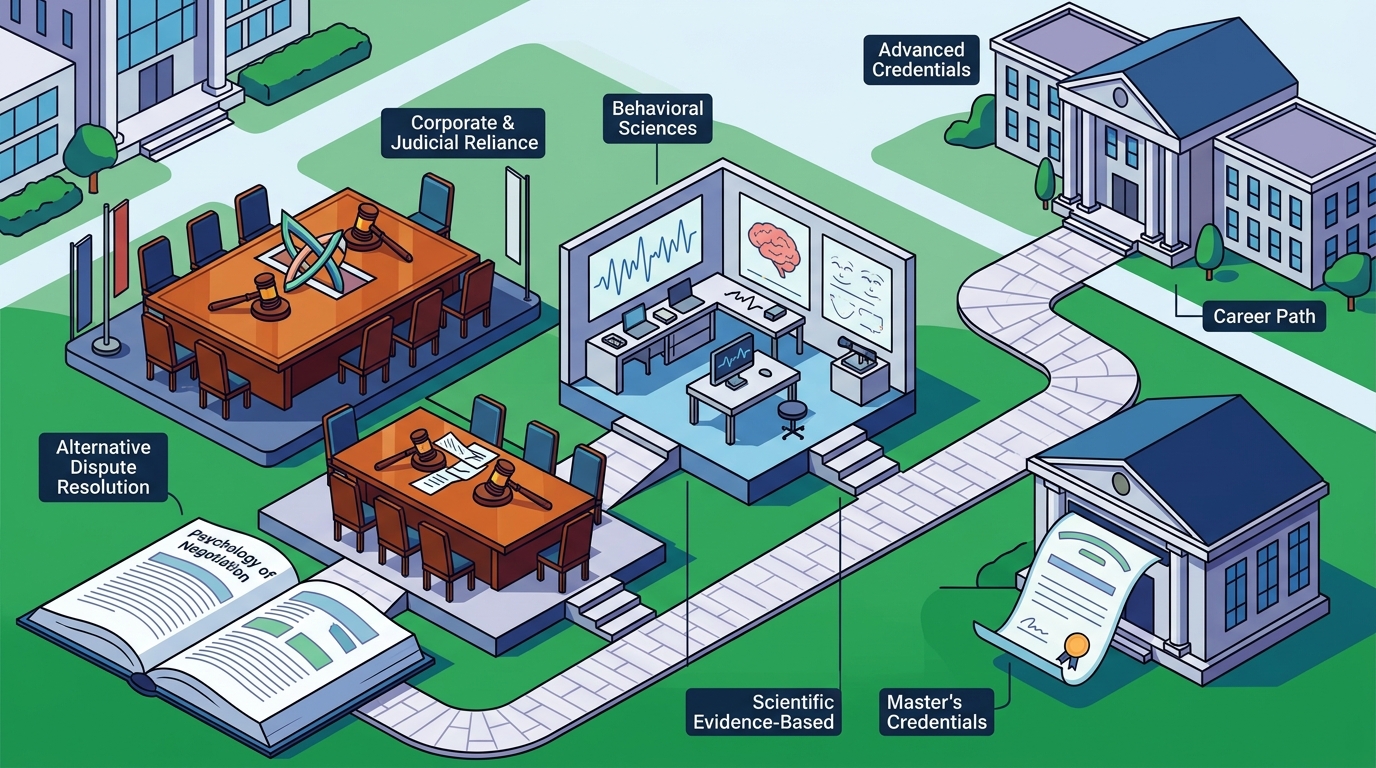
According to recent labor market projections, the demand for professional mediators is projected to grow by twenty percent over the next decade. This expansion directly correlates with increasing corporate and judicial reliance on alternative dispute resolution. Professionals seeking advanced credentials must navigate a structured academic pathway. The Master in Psychology of Negotiation provides a rigorous framework for mastering behavioral dynamics. Candidates must align their career objectives with accredited graduate programs that emphasize empirical research and practical application. (About Us Evidentia University)
Step One: Verify Academic Prerequisites and Licensing Requirements
Prospective students must first confirm their undergraduate credentials align with graduate admissions standards. Most accredited programs require a bachelor's degree from an accredited institution. Candidates holding degrees in psychology, criminal justice, or communications typically face fewer transitional hurdles. Behavioral negotiation is the systematic application of psychological principles to de-escalate conflict and secure mutually beneficial agreements. Admissions committees evaluate undergraduate transcripts for quantitative reasoning and research methodology coursework. International applicants must submit standardized English proficiency scores. Professional mediators often hold state-specific certifications that require continuing education credits. You should verify your current licensing status before initiating the application process.
Reviewing Transfer Credit Policies
Many institutions allow graduate students to transfer relevant coursework from previous academic programs. You must submit official transcripts to the admissions office for evaluation. Transfer credits typically reduce the total credit hour requirement. This pathway accelerates your timeline to degree completion. Review the official transfer guidelines to maximize your academic investment.
Step Two: Submit a Targeted Graduate Application Package
Graduate admissions require a comprehensive portfolio that demonstrates your professional readiness. You must draft a statement of purpose that outlines your mediation objectives. Admissions committees prioritize candidates who demonstrate clear career alignment with behavioral science research. The application portal requires official transcripts, professional references, and a current resume. Financial aid applications must be submitted concurrently to secure institutional grants. Tuition structures vary significantly between public and private institutions. You should budget for technology fees and digital library access. Professional mediators benefit from early engagement with academic advisors. Submit your complete application package before the fall semester deadline to secure priority enrollment.
Securing Institutional Funding
Graduate programs frequently offer merit-based scholarships for high-achieving applicants. You must complete the federal financial aid application to qualify for institutional grants. Many universities provide payment plans that distribute tuition costs across academic terms. You should consult the financial aid office to explore employer sponsorship options. Professional development grants often cover conference attendance and research materials.
Step Three: Complete Core Behavioral Science Coursework
Graduate curricula emphasize empirical research and cognitive behavioral analysis. Cognitive behavioral analysis is the study of how thought patterns influence decision-making during high-stakes negotiations. Students complete foundational courses in research design and statistical methodology. Advanced modules cover conflict resolution frameworks and cross-cultural communication strategies. You will analyze case studies involving corporate disputes and judicial settlements. Professional mediation is a structured dispute resolution process where a neutral third party facilitates communication between conflicting parties. Coursework requires active participation in simulated negotiation exercises. You must submit weekly research papers that demonstrate analytical proficiency. Final examinations assess your ability to synthesize theoretical concepts with practical applications.
Mastering Behavioral Economics
Specialized modules explore how economic incentives shape negotiation outcomes. You will study behavioral economics frameworks that predict rational and irrational decision-making. Case-based learning requires you to design intervention strategies for complex disputes. You must demonstrate proficiency in ethical guidelines and professional conduct standards. Regular peer reviews strengthen your analytical reasoning and presentation skills.
Step Four: Engage in Specialized Mediation Practicums
Practical training bridges theoretical knowledge with real-world dispute resolution. You must complete supervised clinical hours in accredited mediation centers. Practicum sites include corporate human resources departments and community dispute resolution centers. You will observe senior mediators conducting initial intake assessments. Direct client interaction requires strict adherence to confidentiality protocols. You must document each session using standardized behavioral observation forms. Supervisors evaluate your communication techniques and de-escalation strategies. You will receive constructive feedback to refine your intervention methods. Practicum completion requires a minimum number of documented hours. You must submit a comprehensive practicum portfolio before advancing to thesis research.
Developing Intervention Strategies
Advanced practicums focus on high-conflict family and commercial disputes. You will design customized intervention plans based on client behavioral profiles. Role-playing exercises simulate unpredictable negotiation scenarios. You must demonstrate adaptability when parties introduce new demands. Supervisors assess your ability to maintain neutrality under pressure. You will learn to identify hidden power dynamics and leverage them ethically.
Step Five: Finalize Thesis Research and Professional Certification
Graduate programs require an original research project that contributes to behavioral science literature. You must select a thesis topic that addresses current mediation challenges. Your research proposal requires approval from the faculty review board. You will conduct literature reviews and collect empirical data through surveys or interviews. Statistical analysis software helps you interpret complex behavioral datasets. You must present your findings at a regional academic conference. Thesis defense requires you to justify your methodology and conclusions. Successful completion grants you the Master in Psychology of Negotiation degree. You should pursue professional certification to validate your expertise. Many employers require board certification for senior mediation roles.
Securing Board Certification
Professional certification boards evaluate your academic credentials and practical experience. You must submit proof of supervised mediation hours to qualify. Certification exams assess your knowledge of ethical standards and legal frameworks. You will receive a digital credential that verifies your professional status. Many jurisdictions require annual continuing education to maintain certification. You should join professional associations to access networking opportunities. Certification significantly increases your marketability and earning potential.
Program Options and Delivery Models
| Program Format | Delivery Method | Typical Duration | Target Audience |
|---|---|---|---|
| Standard Graduate Track | Hybrid classroom and online modules | Two academic years | Full-time professionals |
| Accelerated Executive Track | Intensive weekend seminars | Eighteen months | Senior mediators |
| Research Fellowship Track | Independent study and lab work | Twenty-four months | Academic researchers |
| International Practitioner Track | Global virtual collaboration | Two years | Cross-border dispute specialists |
Each delivery model aligns with specific career trajectories. You should select the format that matches your scheduling constraints. Hybrid programs provide face-to-face networking opportunities. Accelerated tracks compress coursework into concentrated learning blocks. Research fellowships emphasize publication and grant acquisition. International tracks facilitate cross-cultural dispute resolution training. You must verify accreditation status before enrolling in any program.
Key Takeaways
- Verify undergraduate transcripts and state licensing requirements before applying.
- Submit a comprehensive application package including financial aid documentation.
- Complete core behavioral science courses emphasizing cognitive behavioral analysis.
- Accumulate supervised mediation hours through accredited practicum sites.
- Defend an original thesis that addresses current dispute resolution challenges.
- Pursue board certification to validate your professional expertise.
- Select a delivery model that aligns with your career trajectory.
Frequently Asked Questions
Can I earn this degree while working full-time as a mediator?
Yes. Many programs offer evening and weekend course schedules. You can complete practicum hours during standard business operations. Hybrid delivery models reduce commuting requirements. You should verify the specific scheduling options before enrolling.
What undergraduate majors qualify for graduate admission?
Psychology, criminal justice, communications, and sociology degrees typically qualify. Admissions committees evaluate your quantitative reasoning and research coursework. You may need to complete prerequisite statistics courses. You should consult the admissions office to verify your eligibility.
How long does the entire program take to complete?
Standard tracks require two academic years of full-time study. Accelerated programs compress the curriculum into eighteen months. Part-time schedules extend the timeline to three years. You should verify the specific program duration before enrolling.
Is financial aid available for graduate negotiation programs?
Institutional grants and merit-based scholarships frequently cover tuition costs. You must complete the federal financial aid application to qualify. Many employers provide professional development reimbursement. You should consult the financial aid office to explore all options.
What certification boards recognize this master's degree?
Professional mediation boards evaluate your academic credentials and practical experience. You must submit proof of supervised hours to qualify for examination. Certification requires annual continuing education to maintain active status. You should verify your jurisdiction's specific certification requirements.
Can international students enroll in online programs?
Yes. Many institutions offer fully remote course delivery. You must submit standardized English proficiency scores to qualify. Virtual collaboration tools facilitate cross-border academic interaction. You should verify visa requirements if you plan to attend on-campus events.
How do I secure practicum placement at a mediation center?
You must submit a practicum request to the academic advisor. The university maintains partnerships with corporate and community dispute centers. You will receive placement recommendations based on your career objectives. You should prepare a professional portfolio to secure competitive placements.
Begin Your Graduate Studies Today
Professional mediators who complete advanced behavioral science training consistently secure higher case volumes and premium consulting rates. You should initiate your application process to secure priority enrollment for the upcoming academic term. Our admissions team provides personalized guidance throughout your application journey. You can explore our comprehensive academic catalog to review all available degree tracks. Visit our official admissions portal to submit your application materials. Contact our student services department to schedule a confidential consultation. Secure your place in the next cohort and elevate your mediation practice.