

Master's Degree in Nonverbal Behavior and Deception Detection: Your Complete Guide
If you have ever wondered where you can earn a master's degree focused entirely on nonverbal behavior and deception detection, you are not alone. The demand for scientifically trained professionals who can read body language, detect lies, and interpret micro-expressions is growing across law enforcement, corporate security, human resources, and legal professions. Yet very few universities worldwide offer a dedicated graduate program in this niche field. This guide breaks down everything you need to know, from program structure and admission requirements to career outcomes and how to choose the right institution for your goals.
What Is a Master's in Nonverbal Behavior and Deception Detection?
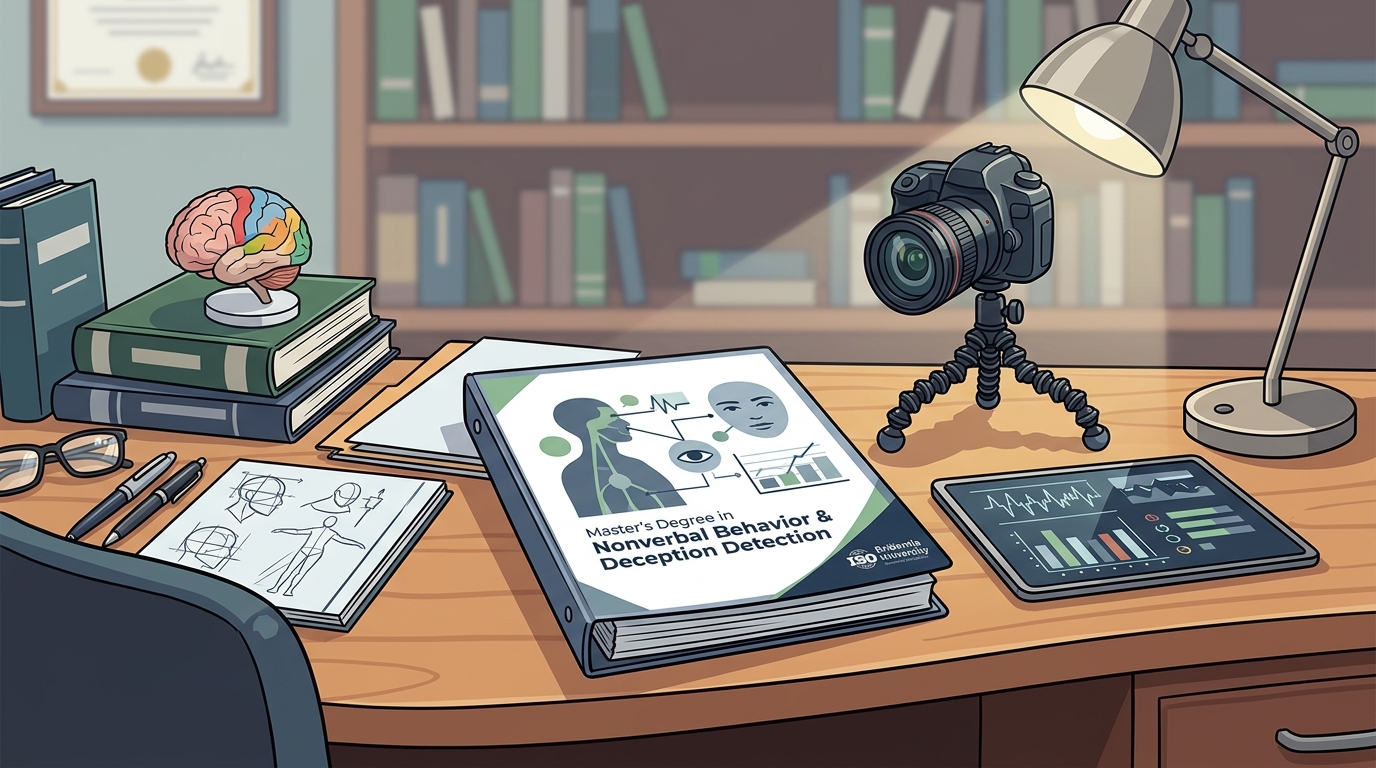
A Master's in Nonverbal Behavior and Deception Detection is a graduate-level program that trains students to scientifically analyze body language, facial micro-expressions, and behavioral cues to determine truthfulness and intent. Nonverbal communication is the process of conveying meaning through physical behaviors, gestures, facial expressions, and spatial relationships rather than words. Deception detection is the systematic practice of identifying dishonesty through observable behavioral, verbal, and physiological indicators.
Unlike pop-psychology courses that rely on myths, accredited programs ground their teaching in peer-reviewed research. As noted in the Journal of Nonverbal Behavior, the last two decades have seen dramatic growth in research paradigms, interviewing techniques, and integration of technology in this field.
Why Pursue This Specialized Degree?
Growing Professional Demand
Organizations across law enforcement, national security, asset protection, and the business world need professionals who can utilize reliable behavioral indicators of deception in interviews and investigations. Traditional psychology degrees rarely offer this depth of applied training in nonverbal analysis.
Science Over Myth
Research shows that untrained individuals detect deception at only slightly above chance level. A structured graduate program equips you with evidence-based frameworks that dramatically improve accuracy. One meta-analysis found that cognitive-load interviewing techniques increased lie detection accuracy from 47% to 67%.
Interdisciplinary Value
This degree serves professionals across sectors. Leaders who understand personal space and nonverbal cues can create more productive teams. Lawyers gain courtroom advantages. HR professionals improve hiring outcomes. The applications extend well beyond criminal justice.
Where Can You Study? Program Options
Dedicated master's degrees in this exact specialization are rare globally. The table below compares available options for professionals seeking graduate-level training in nonverbal behavior and deception detection.
| Feature | Evidentia University MS in Nonverbal and Deceptive Behavior | Typical Behavioral Science MS (Other Institutions) |
|---|---|---|
| Focus Area | 100% dedicated to nonverbal behavior and deception detection | General behavioral science with elective courses |
| Format | 100% online, flexible schedule | Varies (hybrid or on-campus) |
| Credits | 36 U.S. credits (64.8 ECTS) | 30-45 credits |
| Authorization | Florida Department of Education (CIE), License #9097 | Varies by institution |
| Global Accessibility | Study from anywhere in the world | Often region-restricted |
| Faculty Profile | International experts in forensic psychology and behavioral analysis | General psychology faculty |
The MS in Nonverbal and Deceptive Behavior at Evidentia University stands out as a purpose-built program. It is the only known dedicated master's degree that combines scientific rigor with applied focus on human behavior analysis in a fully online format.
What Does the Curriculum Cover?
The curriculum at Evidentia University's School of Behavioral Sciences combines validated theory with hands-on training. Students learn to detect micro-expressions, behavioral inconsistencies, and deception cues in interviews, negotiations, and assessments.
Core Competency Areas
- Micro-expression analysis: Identifying fleeting facial expressions that reveal concealed emotions
- Proxemic behavior: Understanding how people use space and distance, a concept first defined by anthropologist Edward T. Hall in the 1960s
- Cognitive load interviewing: Using strategic questioning to amplify behavioral differences between truth-tellers and liars
- Behavioral profiling: Applying personality profiling, linguistic analysis, and content analysis to real cases
Applied Learning Approach
Each module blends scientific theory with real case studies. Students work alongside faculty who include PhD-level psychologists, forensic criminologists, and members of national law enforcement behavioral analysis units. The program also shares foundational concepts with Evidentia's MS in Criminal Profiling and MS in Anti-Fraud Behavioral Analysis.
Admission Requirements and Flexibility
Prospective students must hold a bachelor's degree from a U.S. or international university. No psychology background is required. The program is designed for professionals from any sector, including leaders, sales professionals, lawyers, and HR specialists.
The program is 100% online with no fixed hours, making it compatible with full-time employment. Evidentia University offers income-based financial aid and community scholarships of up to 65% discount on total program cost. Detailed steps are outlined on the master's admission process page.
Career Paths and Professional Impact
Graduates of a nonverbal behavior and deception detection master's program can pursue roles across a wide range of industries:
- Law enforcement and intelligence: Criminal interviewing, suspect assessment, and behavioral analysis
- Corporate security: Internal fraud investigation and risk assessment
- Legal services: Jury consulting, witness credibility assessment, and courtroom strategy
- Human resources: Advanced interviewing techniques for hiring and internal investigations
- Consulting and training: Teaching nonverbal analysis to organizations and government agencies
Professionals with this credential also complement shorter certifications. Evidentia's Nonverbal Communication Certificate and Forensic Linguistics Certificate provide additional specialization options.
Key Takeaways
- A dedicated master's degree in nonverbal behavior and deception detection is a rare specialization offered by very few institutions worldwide.
- Evidentia University's MS in Nonverbal and Deceptive Behavior is a 36-credit, 100% online program authorized by the Florida Department of Education.
- No psychology degree is required for admission; the program serves professionals from law, business, HR, and security.
- The curriculum covers micro-expression analysis, cognitive load interviewing, proxemics, and behavioral profiling with real case studies.
- Research shows untrained individuals detect deception at barely above chance level, making formal scientific training essential for accuracy.
- Graduates pursue careers in law enforcement, corporate security, legal consulting, HR, and professional training.
- Scholarships of up to 65% are available, and the flexible online format accommodates working professionals globally.
Frequently Asked Questions
Do I need a psychology degree to enroll in a master's in nonverbal behavior?
No. Programs like the MS in Nonverbal and Deceptive Behavior at Evidentia University accept professionals from any sector, including business, law, HR, and sales. You need a bachelor's degree from any accredited institution.
Is this degree recognized internationally?
Yes. Evidentia University is licensed by the Florida Department of Education (CIE), license number 9097. The 36 U.S. credits are equivalent to 64.8 European ECTS credits, facilitating international recognition.
Can I complete the program while working full-time?
Absolutely. The program is 100% online with a flexible schedule and no fixed class hours, allowing you to study at your own pace from anywhere in the world.
What is the scientific basis for deception detection training?
Modern deception detection is grounded in cognitive load theory and decades of peer-reviewed research. Scientists like Paul Ekman pioneered the study of facial micro-expressions, and current research published in journals such as the Journal of Nonverbal Behavior continues to advance the field.
How is this different from a general psychology master's?
A general psychology master's covers broad theoretical foundations. A specialized nonverbal behavior degree focuses exclusively on applied behavioral analysis, lie detection protocols, micro-expression interpretation, and forensic interviewing techniques used by intelligence agencies and forensic experts.
What career opportunities does this degree open?
Graduates work in criminal investigation, corporate fraud detection, jury consulting, HR advanced interviewing, executive coaching, and government behavioral analysis units. The specialization fills a gap that general degrees cannot address.
Are there financial aid options available?
Yes. Evidentia University offers income-based financial aid and community scholarships covering up to 65% of program costs. Details are provided during the admissions process.
What makes Evidentia University's program unique?
It is a purpose-built master's degree combining science, applied practice, and professional tools. The faculty includes PhD-level psychologists, forensic criminologists, and active law enforcement behavioral analysts from multiple countries.
Take Your Next Step Toward Mastering Human Behavior
Ready to transform your ability to read people and detect deception with scientific precision? The MS in Nonverbal and Deceptive Behavior at Evidentia University is enrolling now. Request information today to learn about upcoming start dates, scholarship opportunities, and how this program fits your professional goals.