

Behavioral Cybersecurity Education: How Evidentia University Leads Online Learning
Cybersecurity is no longer just a technology problem. According to recent industry data, the human element is a contributing factor in 60% to 95% of all data breaches, depending on the methodology used. Traditional technical training alone cannot close this gap. That is why a growing number of professionals are turning to programs that merge psychology, criminology, and digital defense. Evidentia University, a Florida-based institution specializing in behavioral and forensic sciences, offers one of the most distinctive approaches to this challenge through its fully online Master in Behavioral Cybersecurity & Cybercriminology.
What Is Behavioral Cybersecurity?
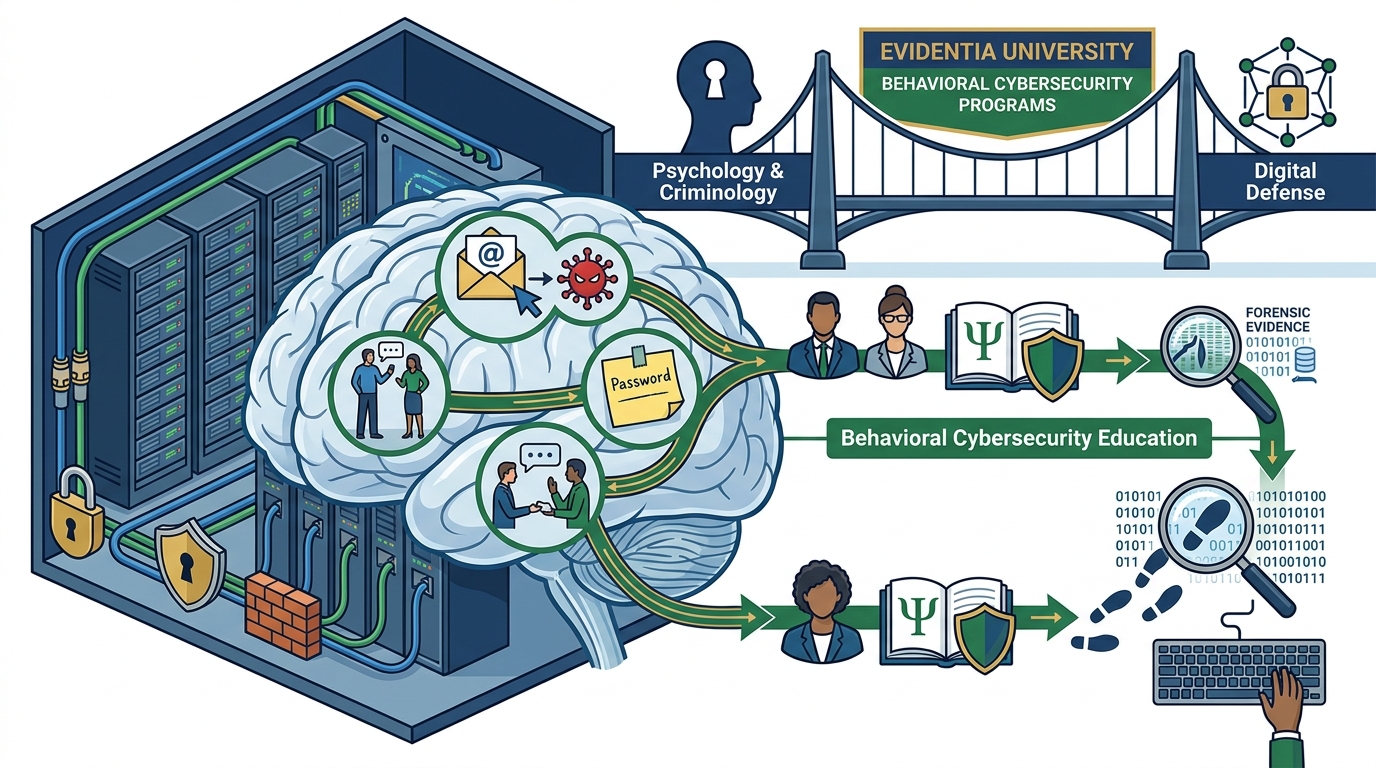
Behavioral cybersecurity is the interdisciplinary field that applies psychological and behavioral science principles to understand, predict, and mitigate cyber threats rooted in human action. Unlike purely technical approaches that focus on firewalls and encryption, behavioral cybersecurity examines why people fall for phishing emails, how social engineers exploit cognitive biases, and what organizational cultures make companies more resilient.
Research published in Frontiers in Psychology highlights that fundamental psychological principles like cognition, motivation, and perception form the basis of a security-by-design philosophy. This growing field demands professionals who can bridge the gap between IT departments and human resources strategy.
The Human Factor Problem in Numbers
The scale of human-driven cyber risk is staggering. The Verizon 2025 Data Breach Investigations Report found that approximately 60% of confirmed data breaches involved a human element through social engineering, errors, or credential misuse. IBM's broader methodology places the figure closer to 95%.
Global cybercrime costs are projected to reach $10.5 trillion annually by the end of 2025, and the average cost of a single data breach now stands at $4.88 million. Meanwhile, an estimated 3.5 million cybersecurity positions remain unfilled worldwide, creating enormous demand for qualified professionals who understand both the technical and behavioral dimensions of security.
| Metric | Value | Source |
|---|---|---|
| Breaches involving human element | 60% (Verizon) to 95% (IBM) | DBIR 2025 / IBM 2024 |
| Global cybercrime cost projection | $10.5 trillion annually | Cybersecurity Ventures |
| Average data breach cost | $4.88 million | IBM Cost of a Data Breach 2024 |
| Unfilled cybersecurity jobs globally | 3.5 million | ISC2 Workforce Study |
| Weekly cyberattacks (global avg.) | 1,968 per organization | SentinelOne 2026 |
These numbers make one thing clear: organizations cannot solve cybersecurity with technology alone. Professionals trained in human behavior analysis are essential.
How Evidentia University Approaches Behavioral Cybersecurity
Evidentia University is an online institution licensed by the Florida Department of Education (CIE), License #9097, specializing exclusively in behavioral and forensic sciences. Its approach to cybersecurity education starts from a unique premise: the human factor is the primary vulnerability, and psychology is the tool to secure it.
Partnership with Fundación Borredá
The university has partnered with Fundación Borredá, a Spanish institution dedicated to promoting security ethics and public-private collaboration. This partnership strengthens the program's ability to prepare students for the realities of the evolving digital threat landscape.
Elite, Research-Active Faculty
The faculty roster includes cybercriminologists, criminal psychologists, and behavioral economists holding doctoral degrees. A team of more than 70 experts contributes to the university's master's programs, blending academic rigor with real-world operational experience in law enforcement, corporate security, and behavioral analysis.
Student-Centered Learning Model
Evidentia University's mission centers on offering programs accessible anytime and everywhere, training a specialized workforce in behavioral and forensic sciences, and fostering lifelong learning through alumni networks and continuing education.
Curriculum Overview and Learning Format
The Master of Science in Behavioral Cybersecurity & Cybercriminology is a 36-credit (64.8 ECTS equivalent) graduate program delivered 100% online in both English and Spanish. The next cohort begins September 1, 2026.
Core Modules
Coursework spans behavioral psychology foundations, cybercriminal profiling, social engineering case studies, indirect personality profiling, influence and persuasion tactics, incident response with emotional crisis management, and a final master's thesis. Each module is designed for immediate professional application.
Flexible Online Experience
Students access live sessions and on-demand recordings, real-world cyberattack case studies, continuous tutoring from expert faculty, exclusive guest speaker sessions with global cybersecurity leaders, and a 24/7 virtual campus. There are no fixed class times, making the program viable for working professionals worldwide.
For professionals looking for shorter commitments, the Professional Certificate Program in Behavioral Cybersecurity & Cybercriminology provides a focused entry point through the School of Continuing Education.
Who Should Enroll?
The program targets three primary professional profiles:
- Cybersecurity and IT professionals who master the technology but want to understand the psychology behind attacks and move from reactive incident response to proactive threat anticipation.
- Investigators and criminologists seeking to apply behavioral profiling and analysis techniques to cyberspace and digital crime.
- Security directors, risk managers, and CISOs who need to design human-centric 360-degree security strategies and build a resilient organizational culture.
A cybercriminologist is a specialist who studies the causes, patterns, and prevention of crimes committed in digital environments using behavioral science methods. No prior technical cybersecurity expertise or psychology background is required to enroll; the program bridges both disciplines from the ground up.
Traditional Cybersecurity Training vs. Behavioral Cybersecurity Education
Understanding the difference between conventional technical certifications and a behavioral cybersecurity degree is essential for choosing the right career path.
| Dimension | Traditional Cybersecurity Training | Behavioral Cybersecurity Education |
|---|---|---|
| Focus | Tools, networks, encryption | Human behavior, psychology, criminology |
| Threat model | Technical vulnerabilities | Social engineering, cognitive biases |
| Response style | Reactive (post-incident) | Proactive (anticipation and prevention) |
| Employee role | Liability to manage | Sensor and first line of defense |
| Credential type | Vendor certifications (CompTIA, CISSP) | Graduate degree (M.S.) with research component |
| Career outcome | Security analyst, pen tester | Human risk strategist, CISO advisor, cybercriminologist |
A human risk strategist is a professional who designs organizational policies, training frameworks, and behavioral nudges to reduce the likelihood of human-caused security incidents. As AI automates technical anomaly detection, the ability to understand human intent and manipulation becomes a decisive career differentiator.
Key Takeaways
- Human error contributes to 60% to 95% of all cybersecurity breaches, making behavioral expertise critical.
- Behavioral cybersecurity merges psychology, criminology, and digital defense to address threats that technology alone cannot solve.
- Evidentia University offers a fully online, 36-credit Master of Science specifically designed around the human factor in cyber risk.
- The program is taught by an international faculty of 70+ experts, including criminal psychologists and cybercriminologists.
- Grants of up to 60% and interest-free payment plans make the program financially accessible.
- No prior technical or psychology background is required; the curriculum bridges both disciplines.
- Graduates are prepared for high-demand roles including human risk strategist, CISO advisor, and cybercrime investigator.
Frequently Asked Questions
What is behavioral cybersecurity?
Behavioral cybersecurity is the application of psychological and behavioral science to understand, predict, and prevent cyber threats that exploit human action. It addresses the cognitive and social factors behind phishing, social engineering, and insider threats.
Does Evidentia University require a technical background for admission?
No. The Master in Behavioral Cybersecurity & Cybercriminology is designed as a bridge between technical and social science disciplines. Students from psychology, criminology, law enforcement, and IT backgrounds all find a clear learning path.
Is the program fully online?
Yes. The program is 100% online with no fixed class times. Students access live sessions, on-demand recordings, case studies, and tutoring through a 24/7 virtual campus, making it ideal for working professionals.
How many credits does the master's program require?
The program requires 36 U.S. academic credits, equivalent to 64.8 European ECTS. It is an official Master of Science degree awarded by Evidentia University, licensed by the Florida Department of Education.
What careers can graduates pursue?
Graduates are prepared for roles such as human risk strategist, cybercrime investigator, corporate security consultant, CISO advisor, and behavioral cybersecurity analyst in sectors including consulting, risk management, and law enforcement.
How is this different from a CompTIA or CISSP certification?
Technical certifications teach tool-based defense. This master's degree teaches the psychology behind why attacks succeed and how to anticipate them by analyzing attacker behavior, victim vulnerability, and organizational culture. It is a strategic layer that complements technical credentials.
Are financial aid options available?
Yes. Evidentia University offers personalized grants of up to 60%, flexible interest-free payment plans, and institutional scholarships based on financial need. Visit the tuition and grants page for details.
When does the next cohort start?
The next cohort for the Master in Behavioral Cybersecurity & Cybercriminology begins September 1, 2026. Early enrollment is recommended to secure grant availability.
Take the Next Step in Your Cybersecurity Career
If you are ready to move beyond technical tools and become a strategist of the human factor in cyberspace, explore the Master in Behavioral Cybersecurity & Cybercriminology at Evidentia University. Request information today with no commitment and discover how grants of up to 60% can make your investment in a graduate-level cybersecurity education more accessible than you think.