

How to Become a Certified Criminal Profiler Through Online Graduate Studies
Criminal profiling is one of the most sought-after specializations in forensic and behavioral science, yet the path to becoming a qualified profiler is widely misunderstood. Unlike what television shows suggest, profiling is not driven by intuition. It is a structured, evidence-based discipline that demands graduate-level education, scientific methodology, and real-world investigative experience. Whether you are a working law enforcement professional, a psychology graduate, or a career changer, online graduate programs now make it possible to gain the specialized training you need without relocating. This guide walks you through every step, from foundational education to professional certification and career launch.
What Is Criminal Profiling, Really?
Criminal profiling is the systematic application of behavioral science, victimology, and crime-scene analysis to infer relevant offender characteristics and help investigators prioritize hypotheses and resources. It is not a psychic gift or a single job title. In practice, profilers combine deductive reasoning from scene behavior, inductive comparisons across similar cases, psychological inference, and geographic cues to produce transparent, auditable conclusions.
The most persistent myth is that you can simply "become a profiler." Within units like the FBI's Behavioral Analysis Unit (BAU), profiling is performed by highly experienced agents or forensic psychologists who first built long careers in investigations. Understanding this reality is the first step toward planning your education correctly.
Education Requirements for Criminal Profilers
Most agencies require at minimum a bachelor's degree in psychology, criminology, criminal justice, or forensic science. However, specialized roles, including positions in the FBI's BAU, expect candidates to hold graduate-level education such as a master's degree in forensic behavioral science or criminal justice.
Undergraduate Foundation
A bachelor's degree introduces core concepts like abnormal psychology, crime scene analysis, and criminal behavior theory. Common majors include psychology, criminal justice, and criminology.
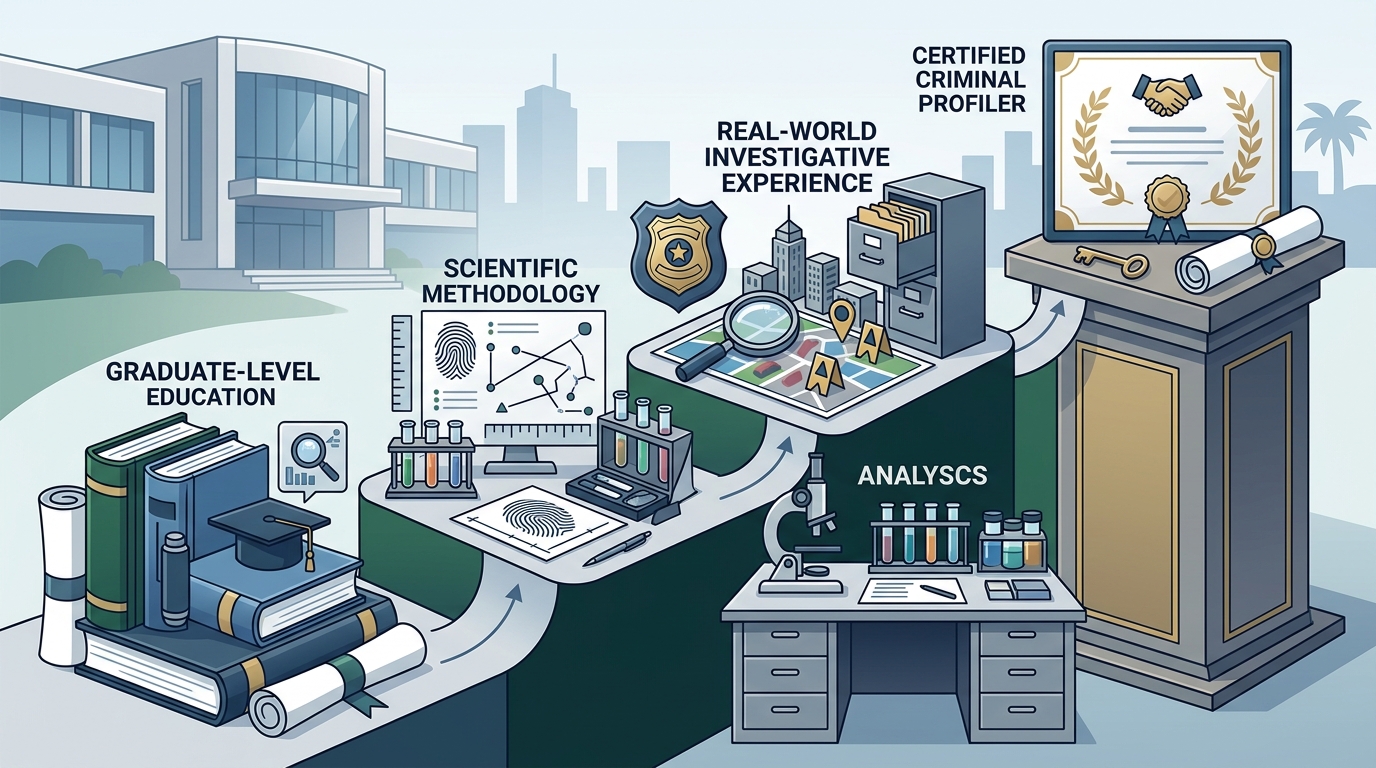
Graduate-Level Specialization
A graduate degree is where you gain the advanced analytical and methodological skills that set profilers apart. Programs like the Master of Science in Criminal Profiling at Evidentia University provide 36 U.S. credits of focused training in behavioral analysis methods taught by practitioners with backgrounds in elite law enforcement units.
Practical Experience
Alongside formal education, hands-on investigative experience remains essential. Many professionals enter profiling after years in roles such as detective, crime analyst, or forensic psychologist.
| Stage | Typical Credential | Focus Areas | Timeline |
|---|---|---|---|
| Foundation | Bachelor's Degree | Psychology, Criminal Justice, Criminology | 4 years |
| Specialization | Master's Degree (e.g., M.S. in Criminal Profiling) | BEA, Geographic Profiling, Forensic Psychology | 1-2 years |
| Professional Certificate | Certificate in Criminal Profiling | Deductive, Inductive, and Psychological Methods | 12 weeks |
| Field Experience | Law Enforcement / Consulting Role | Crime Scene Investigation, Case Analysis | 3-5+ years |
Choosing the Right Online Graduate Program
Not all online programs are created equal. When evaluating options, prioritize programs that offer science-based methodology, real-case applications, and faculty with actual law enforcement or forensic consulting experience.
What to Look For
Evidentia University's School of Crime Science stands out by combining theoretical rigor with practical application. The curriculum covers case studies, simulations, and projects using tools like nonverbal behavior analysis and geographic profiling. Faculty includes former FBI BAU special agents, forensic criminologists, and behavioral analysis section commanders.
Flexibility for Working Professionals
A quality online program should provide 100% asynchronous access to video lessons, readings, and a virtual library. Evidentia University's format is designed for professionals who need to study on their own schedule while still receiving daily tutor support and substantive faculty feedback. You can explore the full curriculum to see how courses are sequenced.
Core Profiling Methods You Will Study
Behavioral Evidence Analysis (BEA) is a deductive method of criminal profiling considered the gold standard in the field. Unlike older inductive methods that rely on statistical comparisons to solved cases, BEA bases all conclusions only on the physical and behavioral evidence of the specific case being investigated. The goal is to avoid speculation, arbitrariness, and cognitive biases.
The BEA method follows a structured four-step process where each step builds logically on the last, ensuring the final profile is grounded in fact. You can read a detailed breakdown on the BEA methodology page.
Geographic profiling is another critical technique. By mapping crime locations, analysts determine an offender's "anchor point" and prioritize areas for surveillance. Students also learn to distinguish modus operandi from signature, a fundamental skill for linking serial crimes.
Certification and Credential Options
Professional certification is a way to validate your skills beyond a degree. Certification in criminal profiling is the formal recognition of competency in profiling methodologies, typically awarded after completing a structured program and passing assessments.
Evidentia University offers a Professional Certificate in Criminal Profiling that unfolds over 12 weeks with continuous practice, guided feedback, and quality criteria replicable in real cases. The certificate covers three courses: Deductive Method (Criminal Investigative Analysis), Inductive Method (Statistical and Comparative Profiling), and Psychological Method (Indirect Personality Profiling).
Other options include the Certified Criminal Profiler (CCP) board certification from the McAfee Institute, which focuses on topics like victimology and interview techniques. However, certificates are usually supplements to, not substitutes for, comprehensive degree programs and hands-on experience.
Career Paths and Salary Expectations
Instead of aiming for a job title that rarely exists as a standalone position, professionals build careers in related roles. Common career paths include crime analyst, investigative consultant, forensic psychologist, and academic researcher. Graduates from programs like Evidentia University's are equipped for roles in government agencies, private security firms, international organizations, and academia.
According to Indeed, entry-level FBI special agents earned approximately $52,440 per year as of 2021, with locality pay raising total compensation to between $61,816 and $74,171 depending on location. Mid-career professionals in behavioral analyst or forensic psychologist roles can expect higher earnings as they gain experience and advanced credentials.
The career path is not strictly linear. Diverse backgrounds in psychology, academia, or private consulting can all lead into profiling work, emphasizing adaptability and continuous learning.
Key Takeaways
- Criminal profiling is a structured, evidence-based discipline, not an intuition-driven art form.
- A bachelor's degree is the minimum requirement, but a master's degree in criminal profiling or forensic psychology significantly strengthens your candidacy.
- Behavioral Evidence Analysis (BEA) is the gold standard methodology taught in leading programs.
- Online graduate programs like Evidentia University's M.S. in Criminal Profiling offer flexible, practitioner-led training with real-case applications.
- Professional certificates (12-week intensives) complement graduate degrees but do not replace them.
- Career paths include crime analyst, forensic psychologist, investigative consultant, and academic researcher.
- Continuous professional development, networking, and field experience are essential for advancement in this competitive field.
Frequently Asked Questions
Do I need a law enforcement background to study criminal profiling?
No. Programs like Evidentia University's Master in Criminal Profiling are designed for a wide range of professionals, including psychologists, legal experts, and investigative journalists. A law enforcement background is beneficial but not required for enrollment.
What degree do I need to become a criminal profiler?
Most agencies require at least a bachelor's degree in psychology, criminal justice, or a related field. However, graduate-level education such as a Master of Science in Criminal Profiling is strongly recommended for specialized roles.
How long does it take to become a criminal profiler?
The full journey can take eight to ten years, including earning undergraduate and graduate degrees, gaining field experience, and potentially completing a law enforcement academy. Timelines vary based on educational path and agency requirements.
What is Behavioral Evidence Analysis (BEA)?
BEA is a deductive method of criminal profiling that bases all conclusions only on the physical and behavioral evidence found in the specific case being investigated. It was developed to be more systematic, testable, and scientifically defensible than earlier profiling models.
Can I earn a criminal profiling degree entirely online?
Yes. Evidentia University offers a 100% online M.S. in Criminal Profiling consisting of 36 U.S. credits, delivered through asynchronous video lessons, real-world case studies, and daily tutor support.
What is the salary range for criminal profilers?
Salaries vary widely based on experience, education, and employer. Entry-level FBI special agents earned approximately $52,440 per year as of 2021, with locality adjustments bringing totals higher. Mid-career behavioral analysts and forensic psychologists typically earn more.
Is a certificate in criminal profiling worth it?
A professional certificate is valuable as a focused supplement to a degree. It demonstrates competency in specific methodologies and can enhance your resume, but it is generally not a substitute for a full graduate degree and practical experience.
What career roles can I pursue with a criminal profiling education?
Graduates pursue roles as crime analysts, investigative consultants, forensic psychologists, security consultants, academic researchers, and behavioral analysts within law enforcement agencies and private organizations.
Take the Next Step in Your Profiling Career
If you are ready to move beyond myths and master the science of criminal profiling, explore the Master of Science in Criminal Profiling at Evidentia University. Request information today to learn about enrollment, grants, and how to start building the career you have been working toward.