

Behavioral Cybersecurity Education: How Evidentia University Leads Online Learning
Cybercrime is projected to cost the world $10.5 trillion annually in 2025, and the human element remains the dominant driver of breaches. According to the 2025 Verizon Data Breach Investigations Report, roughly 60-68% of confirmed data breaches involve a human factor such as social engineering, error, or credential misuse. Traditional technical defenses alone are not enough. That is why Evidentia University, a Florida-based institution specializing in behavioral and forensic sciences, has built an online learning platform dedicated to understanding the psychology behind cyber threats. This guide explores how the university bridges behavioral science and cybersecurity to prepare a new generation of professionals.
What Is Behavioral Cybersecurity?
Behavioral cybersecurity is the interdisciplinary field that applies psychology, criminology, and behavioral science to understand and counter cyber threats rooted in human behavior. Unlike traditional cybersecurity, which focuses on firewalls, encryption, and network architecture, behavioral cybersecurity examines why people fall for phishing attacks, how insider threats develop, and what cognitive biases attackers exploit.
According to research published in Springer's Cybersecurity journal, the majority of cyber incidents are human-enabled, making a paradigm shift toward behavioral research essential. Evidentia University's School of Behavioral Sciences applies scientific principles to understanding the mind and emotions, training experts who can address contemporary challenges in areas from fraud prevention to cybersecurity.
Why the Human Factor Matters More Than Ever
The statistics are striking. A Stanford University study found that 88% of cybersecurity breaches are caused by human error. The 2025 Verizon DBIR confirms that 68% of breaches involved a human element, while IBM reports the global average cost of a data breach reached $4.44 million in 2025.
Social Engineering: The Dominant Attack Vector
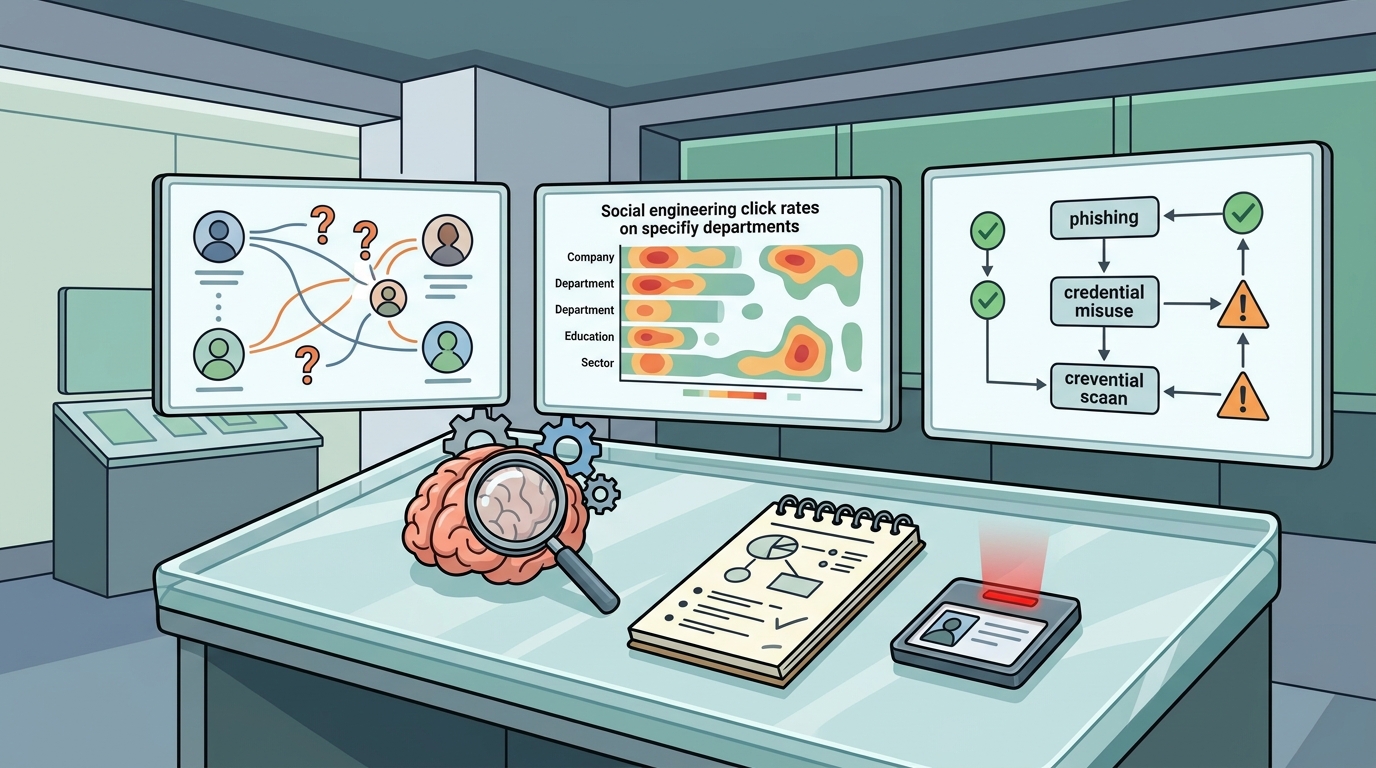
Social engineering is the practice of manipulating people into divulging confidential information or performing actions that compromise security. Proofpoint's 2025 Human Factor report found that more than 90% of advanced persistent threat (APT) social engineering campaigns disguise themselves as collaboration requests. Attackers are not just hacking systems; they are hacking minds.
The Skills Gap in Human-Centered Security
Gartner projects that by 2027, 50% of CISOs will formally adopt human-centric design practices. Yet the cybersecurity workforce, estimated at 4.7 million professionals globally, still lacks specialists who understand the behavioral dimension. This gap is precisely what Evidentia University's programs are designed to fill.
Evidentia University's Behavioral Cybersecurity Programs
Evidentia University offers multiple pathways into behavioral cybersecurity education, from short professional certificates to a full master's degree. The table below summarizes the key options:
| Program | Type | Format | Key Focus Areas |
|---|---|---|---|
| MS in Behavioral Cybersecurity & Cybercriminology | Master's Degree | 100% Online | Criminal profiling, victimology, cyber risk strategy |
| Professional Certificate in Behavioral Cybersecurity & Cybercriminology | Certificate (12+ weeks) | 100% Online | Influence, social engineering, cybercrime prevention |
| Cybersecurity from a Psychological Perspective | Advanced Program (8 weeks) | 100% Online | Cyber-profiling, online personality analysis |
All programs are delivered through the School of Continuing Education and graduate schools at Evidentia University, which is licensed by the Florida Department of Education.
Curriculum Deep Dive: What You Will Learn
The Master's in Behavioral Cybersecurity and Cybercriminology integrates psychology, criminology, and strategy to analyze and neutralize the most advanced cyber threats. The curriculum gives students command over the human factor in cyber risk.
Social Engineering and Psychological Influence
Students learn the main techniques of influence and persuasion in negotiation and collaboration processes, and how to apply them in situations related to cyber incidents. Coursework also covers how to influence organization members to adopt cybersecure behaviors.
Cybercriminology and Victimology
The program explores the dynamic intersection of criminological theories, victimology, and the evolving landscape of cybercrime. Students gain comprehensive insights into victimization experiences of both individuals and organizations, learning to profile cybercriminals and create more robust defenses.
Behavioral Analysis and Cyber-Profiling
Students develop skills to create online personality profiles, analyze digital behavior, and apply cyber-profiling as a practical cybersecurity tool. Each module is designed for immediate application in protecting digital assets.
World-Class Faculty and Industry Partnerships
Evidentia University's faculty includes cybercriminologists, psychologists, researchers, and cybersecurity strategists with frontline experience. The university employs a team of more than 70 experts across its master's programs, including professionals with PhDs in Psychology, Criminology, Economics, and Political Science. Notable credentials among faculty include former law enforcement commanders, criminal profiling specialists, and behavioral economics directors at major financial institutions.
The university has also partnered with Fundacion Borreda, a security-focused institution, to strengthen cybersecurity and cybercrime education. This collaboration ensures students receive training backed by real-world security expertise and ethical standards.
The Online Learning Platform Experience
Evidentia University is a fully online institution accessible to students worldwide. The platform combines the flexibility of self-paced study with live interactive sessions led by expert faculty. Students who cannot attend live sessions can access recordings at any time.
Practical, Case-Based Learning
Students analyze and solve real cases of complex cyberattacks, from social engineering incidents to high-impact insider threats. Daily tutor support from experts in cybercriminology and behavioral analysis ensures questions are resolved promptly.
Assessment and Certification
Courses require passing quizzes (50% of the final grade) and a final activity (50%), with a minimum score of 7 out of 10. Graduates earn credentials issued by the School of Continuing Education at Evidentia University, Florida, USA. The university follows the Carnegie unit of credit hours recognition for its graduate programs.
Career Outcomes and Industry Demand
Cybersecurity unemployment is projected to remain near 0% through 2025 and beyond, according to Cybersecurity Ventures. Information security analyst positions in the U.S. are expected to grow 32% between 2022 and 2032, per the Bureau of Labor Statistics. Graduates of behavioral cybersecurity programs are uniquely positioned for roles in consulting, risk management, corporate security, and threat intelligence.
Upon completing the Master's in Behavioral Cybersecurity, graduates are prepared to lead the "human firewall" strategy in their organizations. The School of Behavioral Sciences notes that its graduates take on key roles in forensic psychology, security, organizational behavior consulting, and strategic negotiation across government agencies, private companies, and international organizations.
Key Takeaways
- Behavioral cybersecurity is the study of how human psychology drives cyber threats and defenses, not just technical controls.
- Between 60% and 88% of cybersecurity breaches involve human error or social engineering, depending on the methodology used.
- Evidentia University offers a full Master's degree, professional certificates, and short courses in behavioral cybersecurity, all 100% online.
- The curriculum uniquely integrates psychology, criminology, and strategy to address the human factor in cyber risk.
- Faculty includes over 70 experts with PhDs and real-world experience in law enforcement, criminal profiling, and behavioral economics.
- Cybersecurity job growth is projected at 32% through 2032, with near-zero unemployment in the field.
- Graduates are prepared for high-demand roles including threat intelligence, corporate security strategy, and cybercriminology consulting.
Frequently Asked Questions
What is behavioral cybersecurity?
Behavioral cybersecurity is the interdisciplinary field that applies behavioral science, psychology, and criminology to understand, prevent, and respond to cyber threats that exploit human behavior. It focuses on why people are vulnerable to attacks like phishing and social engineering rather than purely on technical defenses.
Who should study behavioral cybersecurity?
The programs are designed for cybersecurity analysts and technicians who want to understand the psychology behind attacks, as well as professionals in psychology, criminology, risk management, and corporate security seeking to specialize in the digital domain.
Are Evidentia University's programs fully online?
Yes. All behavioral cybersecurity programs at Evidentia University are delivered 100% online, combining self-paced materials with live sessions and daily tutor support. Students can access recordings if they miss a live class.
What credentials will I earn?
Depending on the program, you will earn either a Master of Science degree or a Professional Certificate issued by Evidentia University, which is licensed by the Florida Department of Education. Certificates reflect a rigorous, scientific training approach.
How long do the programs take?
The Professional Certificate requires 12 or more weeks. The Cybersecurity from a Psychological Perspective course runs 8 weeks. The Master's program length varies by enrollment pace, as the 100% online format allows flexible scheduling.
What makes Evidentia University different from other cybersecurity programs?
Evidentia University is one of the few institutions globally that specializes exclusively in behavioral and forensic sciences. Its cybersecurity programs emphasize the human factor, combining criminological theory, psychological profiling, and strategic analysis rather than focusing solely on technical tools.
What is the job outlook for behavioral cybersecurity graduates?
The outlook is strong. Cybersecurity unemployment remains near zero, and information security analyst roles are growing 32% through 2032. Behavioral cybersecurity specialists are in particular demand as organizations recognize that human-centric security strategies are essential.
Does Evidentia University offer financial aid?
Yes. Evidentia University offers financial aid to those who qualify, including scholarships, grants, and partnership-based funding opportunities. Contact the admissions team for details.
Take the Next Step in Behavioral Cybersecurity
The cyber threat landscape demands professionals who understand both technology and human behavior. Whether you are looking to earn a Master's in Behavioral Cybersecurity and Cybercriminology or start with a Professional Certificate, Evidentia University provides the scientific rigor and practical training to set you apart. Apply now for Fall 2026 and join a global community transforming how we understand and combat cybercrime.