
Where Can I Get a Master's Degree in Nonverbal Behavior and Deception Detection?
If you have ever wondered whether science-backed training in reading body language and spotting deception actually exists at the graduate level, the answer is yes. A growing number of professionals in law enforcement, corporate security, human resources, and legal practice are seeking formal education in nonverbal behavior analysis. Yet dedicated master's programs in this niche remain rare. This guide breaks down what these programs cover, where to find them, what you will learn, and how a graduate degree in deception detection can reshape your career trajectory in behavioral and forensic sciences.
What Is Nonverbal Behavior and Deception Detection?
Nonverbal behavior is the study of how humans communicate through body language, facial expressions, gestures, posture, and spatial distance rather than words. Deception detection is the systematic process of identifying dishonest communication by analyzing verbal and nonverbal cues using validated scientific methods. Together, these disciplines form a rigorous field grounded in psychology, criminology, and communication science.
Research published in Personality and Social Psychology Review found that untrained individuals achieve only about 54% accuracy when distinguishing lies from truths, barely above chance. This underscores why formal, evidence-based education matters far more than intuition alone.
Why Pursue a Master's Degree in This Field?
Short workshops and online certificates offer a useful introduction, but a master's degree provides the depth required to apply these skills in high-stakes settings. Graduate-level training covers research methodology, ethical frameworks, and supervised practical analysis that shorter programs simply cannot replicate.
Professional Differentiation
Holding a master's degree signals scientific rigor and separates you from self-proclaimed experts whose conclusions may lack empirical backing. Employers in law enforcement, intelligence, and corporate compliance increasingly value graduate credentials when hiring behavior analysts.
Growing Job Market
The U.S. Bureau of Labor Statistics projects about 12,900 annual openings for psychologists, while behavioral health occupations overall are expected to grow 13% between 2023 and 2033. A specialized master's positions you at the intersection of behavioral science and applied security, a niche with strong demand.
Where to Study: The MS in Nonverbal and Deceptive Behavior
Evidentia University offers one of the few dedicated graduate programs worldwide: the Master of Science in Nonverbal and Deceptive Behavior. Based in Florida and delivered 100% online, this program is specifically designed for professionals who want to master scientific protocols for analyzing deception and nonverbal communication.
The university is licensed by the Florida Department of Education (CIE) under license number 9097 and is authorized to offer postsecondary programs under Chapter 1005 of the Florida Statutes. The degree comprises 36 U.S. academic credits, equivalent to 64.8 European ECTS, making it internationally recognized.
| Feature | Evidentia University MS in Nonverbal & Deceptive Behavior | Typical Short Certificate Programs |
|---|---|---|
| Credits / Duration | 36 U.S. credits (64.8 ECTS) | 1-12 weeks, no academic credit |
| Delivery | 100% online, flexible schedule | Online or in-person workshops |
| Credential | Master of Science degree | Certificate of completion |
| Regulatory Oversight | Florida Dept. of Education (CIE) | Varies; often none |
| Research Component | Yes, thesis or capstone | No |
| Faculty | 70+ international PhDs and practitioners | 1-3 instructors |
| Doctoral Pathway | Valid for European PhD applications | Not applicable |
What You Will Learn: Curriculum Highlights
The MS in Nonverbal and Deceptive Behavior combines theory with intensive applied practice. From day one, students analyze real videos of depositions, interviews, and negotiations, building applicable skills rather than accumulating theory alone.
Core Skill Areas
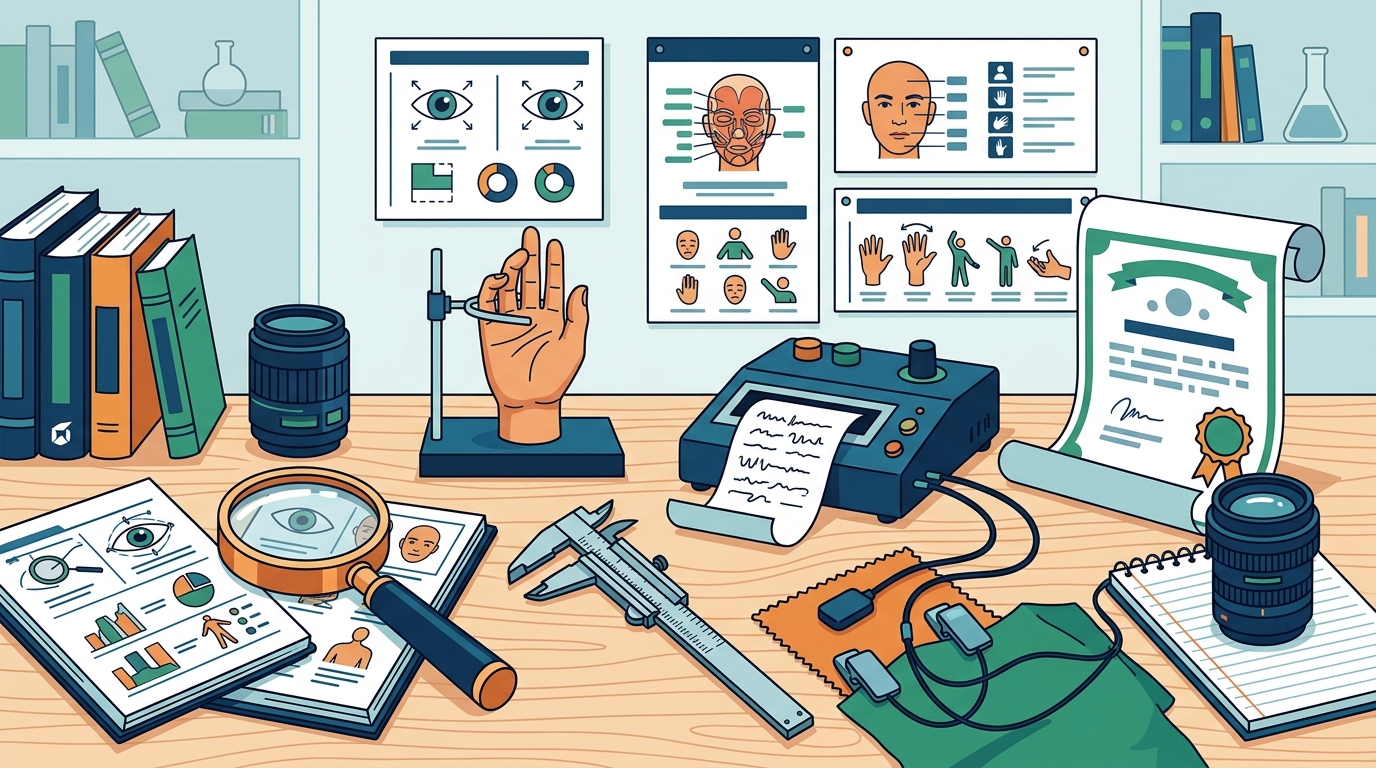
- Micro-expression analysis: Learn to identify fleeting facial expressions linked to concealed emotions using frameworks rooted in the work of pioneers like Paul Ekman.
- Kinesics and proxemics: Study how body movement and the use of personal space reveal hidden intentions in social and professional contexts.
- Verbal deception cues: Explore validated methods such as the Strategic Use of Evidence (SUE) and Cognitive Credibility Assessment (CCA), which research confirms produce diagnostic verbal cues to deceit.
- Forensic linguistics: Analyze statement content to detect inconsistencies and indicators of deception in written and spoken communications.
Faculty Excellence
Courses are taught by a team of more than 70 international experts, including PhDs in psychology and criminology, criminal psychologists, and active law enforcement officers who advise agencies and governments worldwide.
Complementary Programs
Students interested in related specializations can also explore the MS in Criminal Profiling or the MS in Anti-Fraud Behavioral Analysis, both of which incorporate nonverbal behavior modules. For a shorter entry point, the Certificate in Nonverbal Communication offers a 12-week intensive pathway.
Career Outlook and Industry Demand
Behavioral science is one of the fastest-growing professional fields. The Bureau of Labor Statistics projects a 14% growth rate for behavioral health science occupations from 2022 to 2032, well above the national average of 5%. Specialized expertise in nonverbal behavior and deception detection opens doors across multiple sectors.
Where Graduates Work
- Law enforcement and intelligence: Conducting investigative interviews and assessing witness credibility.
- Corporate security and HR: Screening candidates, leading internal investigations, and managing fraud prevention.
- Legal practice: Advising attorneys on jury selection, witness preparation, and courtroom behavior analysis.
- Consulting: Offering expert behavioral analysis for negotiations, risk assessment, and executive coaching.
Evidentia University has partnerships with organizations like the Spanish Ministry of Interior, the Florida Sheriffs Association, and the World Bank Group, reflecting the real-world applicability of its programs.
Admissions Requirements and How to Apply
The admissions process at Evidentia University is straightforward. You do not need to be a psychologist to enroll. The program is designed for professionals from any sector, including leaders, sales professionals, lawyers, and HR specialists.
What You Need
- A bachelor's degree from a U.S. or international university.
- Three letters of recommendation.
- A current resume or CV.
- Language proficiency assessment (if studying in a non-native language).
Programs are available in both English and Spanish. Early applicants may qualify for institutional grants covering up to 60% of tuition, plus additional direct discounts.
Key Takeaways
- Dedicated master's programs in nonverbal behavior and deception detection are rare; Evidentia University offers one of the few globally.
- The MS in Nonverbal and Deceptive Behavior is a 36-credit, 100% online degree licensed by the Florida Department of Education.
- Untrained humans detect lies at roughly 54% accuracy; formal scientific training significantly improves performance.
- The program is open to professionals from any background, not just psychologists.
- Behavioral science occupations are projected to grow 13-14% through the early 2030s, well above average.
- Faculty includes over 70 international PhDs, criminal psychologists, and active law enforcement professionals.
- Graduates apply their skills across law enforcement, corporate security, legal consulting, and fraud prevention.
Frequently Asked Questions
Do I need a psychology degree to enroll in a master's program in nonverbal behavior?
No. Evidentia University's MS in Nonverbal and Deceptive Behavior is designed for professionals from any sector. You need a bachelor's degree in any discipline to be eligible for admission.
Is the degree internationally recognized?
Yes. The program comprises 36 U.S. credits (equivalent to 64.8 European ECTS) and is issued by a university licensed by the Florida Department of Education. The degree is valid for applying to doctoral programs in Europe following standard equivalence processes.
Can I complete the program while working full time?
Absolutely. The master's is 100% online with no fixed class times. It is built from the ground up for working professionals who need to balance studies with career and personal obligations.
How accurate is human lie detection without training?
Meta-analytic research shows that untrained people correctly identify lies and truths at an average rate of about 54%, barely above chance. Scientific training that focuses on verbal and nonverbal cue analysis has been shown to meaningfully improve accuracy.
What career paths does this degree support?
Graduates pursue roles in law enforcement interviewing, intelligence analysis, corporate fraud investigation, HR screening, legal consulting, negotiation coaching, and academic research in behavioral sciences.
How does this master's differ from a short certificate?
A master's degree provides 36 credits of in-depth, research-grounded coursework, faculty mentorship, and a thesis or capstone. Certificates typically last a few weeks and do not carry academic credit or regulatory oversight at the same level.
What languages are available?
Evidentia University offers its programs in both English and Spanish. Students can follow video lectures, interact with classmates, and complete assessments in the language that suits them best.
Are scholarships or financial aid available?
Yes. Evidentia University offers income-based financial aid and community scholarships that can cover up to 60% of tuition costs. Early applicants may also receive additional discounts.
Take the Next Step Toward Mastering Human Behavior
If you are ready to move beyond intuition and build real, science-backed expertise in nonverbal behavior and deception detection, now is the time to act. Request information about the MS in Nonverbal and Deceptive Behavior at Evidentia University and discover how a flexible, fully online master's degree can transform your professional future.