

Best Master's Degree for a Career in Behavioral Cybersecurity and Cybercriminology
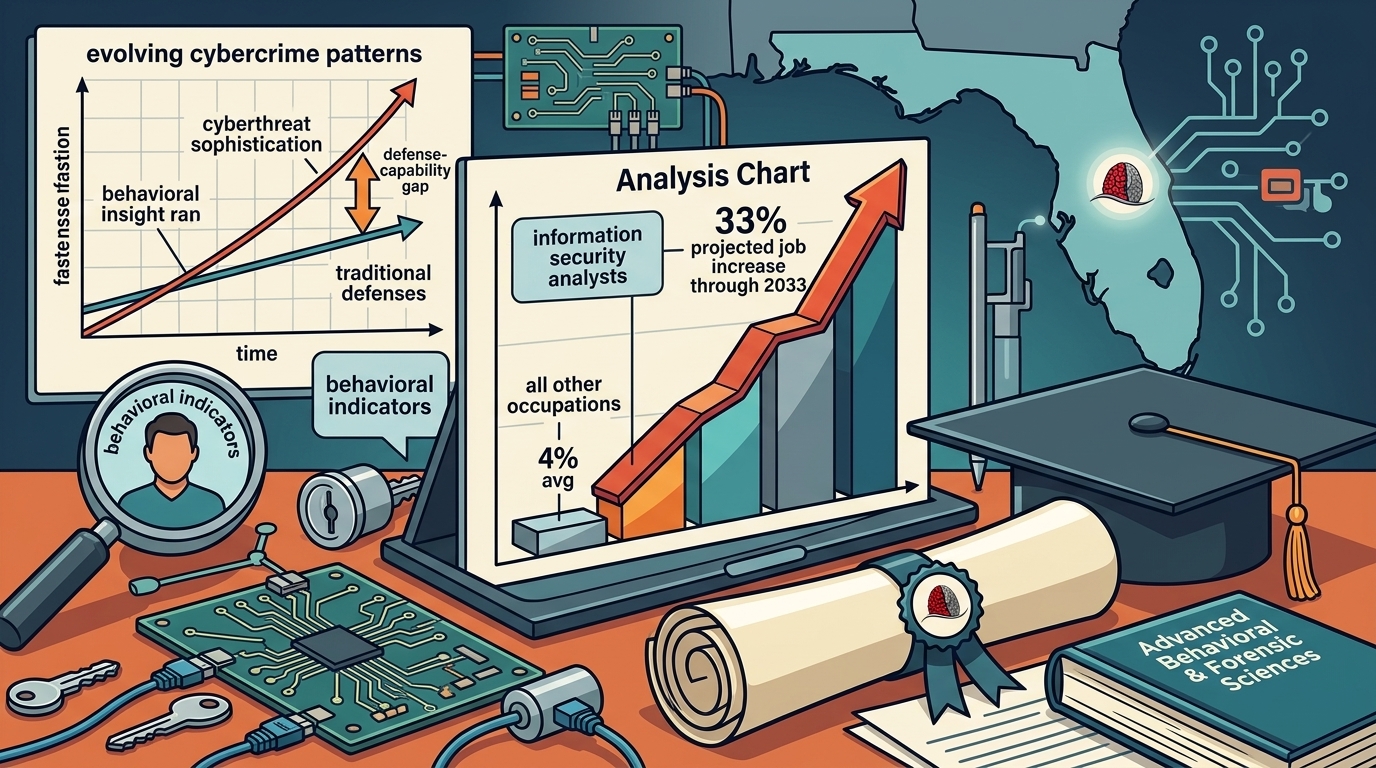
Cybercrime is evolving faster than traditional defenses can keep up. The U.S. Bureau of Labor Statistics projects 33% job growth for information security analysts through 2033, far outpacing the 4% average across all occupations. But here is the gap most professionals miss: the majority of cyberattacks exploit human behavior, not just technical vulnerabilities. That reality has created urgent demand for a new breed of expert who understands the psychology behind cybercrime. Choosing the right master's degree is the first step toward joining this high-impact, high-demand field. This guide breaks down the best graduate programs, career outcomes, and what to look for in a behavioral cybersecurity education.
What Is Behavioral Cybersecurity?
Behavioral cybersecurity is the study of human factors that contribute to cyber risk, including how attackers manipulate psychology and how users make security-related decisions. Unlike traditional cybersecurity, which focuses on firewalls, encryption, and network architecture, this discipline centers on understanding the mind of the attacker and the behavioral vulnerabilities of targets.
Cybercriminology is the scientific study of criminal behavior in digital environments, drawing on criminological theory, psychology, and digital forensics. Together, these fields offer a framework for anticipating and preventing threats that purely technical solutions cannot address.
The Human Factor Problem
According to Security Magazine research cited by UW, human error poses cybersecurity challenges for 80% of businesses. Social engineering attacks, phishing, and insider threats all rely on psychological manipulation rather than code exploits. This is precisely why organizations now seek professionals trained in behavioral analysis alongside cybersecurity strategy.
Why a Master's Degree Matters in This Field
A master's degree provides the theoretical depth and research rigor that professional certifications alone cannot deliver. Technical certifications teach you how to use tools, but a graduate degree in behavioral cybersecurity teaches you to understand why attacks work at a psychological level and how to build defenses around human behavior.
Industry Demand Is Surging
The global cybersecurity workforce gap stands at 4.8 million unfilled positions according to ISC2's 2024 report. The BLS projects approximately 17,300 new openings per year for information security analysts in the U.S. alone. Professionals who can bridge the gap between psychology and technology hold a distinct competitive advantage in this market.
Leadership-Ready Credentials
Graduate-level education positions you for leadership roles such as threat intelligence director, cyber risk strategist, or chief information security officer (CISO). The median annual salary for information security analysts reached $124,910 as of May 2024, with senior leadership roles commanding significantly more.
Types of Master's Programs to Consider
Not all cybersecurity master's degrees are the same. Depending on your career goals, you will want to evaluate programs across several categories.
MS in Behavioral Cybersecurity and Cybercriminology
This is the most specialized option, designed specifically for professionals who want to integrate psychology, criminology, and cybersecurity strategy. Evidentia University offers a Master of Science in Behavioral Cybersecurity and Cybercriminology that focuses on profiling cybercriminals, analyzing social engineering, and understanding the human factor in cyber risk. The program consists of 36 U.S. academic credits (equivalent to 64.8 European ECTS) and is delivered 100% online for working professionals.
MS in Criminal Justice with Cybercrime Concentration
Programs like Boston University's MS in Criminal Justice with a Cybercrime Investigation and Cybersecurity concentration approach the field from a law enforcement and digital forensics perspective. These programs emphasize legal admissibility of digital evidence, forensic examination, and criminological strategy for cybercrime prevention.
MS in Cybersecurity (Technical Focus)
Traditional cybersecurity master's degrees from institutions such as the University of Scranton or Bridgewater State University emphasize technical skills like network defense, cryptography, and incident response. While rigorous, they may lack dedicated coursework in behavioral psychology and criminal profiling.
Program Comparison: Key Factors at a Glance
| Factor | MS Behavioral Cybersecurity (Evidentia University) | MS Criminal Justice - Cybercrime (BU MET) | MS Cybersecurity (Technical Programs) |
|---|---|---|---|
| Primary Focus | Psychology + Criminology + Cyber Strategy | Criminal Justice + Digital Forensics | Network Defense + Encryption + Incident Response |
| Behavioral Science Coursework | Core requirement | Limited electives | Minimal or none |
| Cybercriminal Profiling | Yes | Partial | No |
| Format | 100% Online | Online/Hybrid | Varies |
| Credits | 36 U.S. credits | 32 credits | 30-36 credits |
| Best For | Behavioral analysts, threat intelligence, fraud prevention | Law enforcement, forensic examiners | SOC analysts, security engineers |
Curriculum Essentials to Look For
When evaluating programs, look for a curriculum that bridges both technical and behavioral domains. The best programs integrate psychology, criminology, and applied strategy rather than treating them as separate tracks.
Core Topics in a Strong Program
A well-designed behavioral cybersecurity curriculum should cover social engineering analysis, cybercriminal profiling, victimology in digital environments, insider threat assessment, and behavioral analytics for threat detection. The cybersecurity from a psychological perspective approach is what distinguishes these programs from purely technical alternatives.
Applied Learning and Case Studies
Real-world application is critical. Programs should include analysis of actual cyberattack cases, from social engineering incidents to insider threats. Evidentia University's curriculum, for example, requires students to analyze cybercrime and cybercriminal behavioral patterns using scientific methodologies, not just theoretical frameworks.
Faculty Credentials
Your instructors should hold advanced degrees and have real-world experience. Evidentia University's faculty roster includes PhDs in psychology and criminology, professionals who have led threat intelligence teams, and experts with over a decade of applied cybersecurity experience.
Career Paths and Salary Expectations
Graduates of behavioral cybersecurity programs are uniquely positioned to fill roles that require both technical competence and a deep understanding of human behavior.
Common career paths include cyber threat intelligence analyst, behavioral profiler for cybercrime units, social engineering prevention consultant, insider threat program manager, and cybersecurity policy advisor. According to Georgia Tech, information security analysts are among the top five fastest-growing occupations in the U.S.
Organizations across government, law enforcement, financial services, healthcare, and technology sectors actively recruit professionals who understand the behavioral dimensions of cyber risk. The School of Crime Sciences at Evidentia University prepares graduates for exactly these high-demand, cross-disciplinary roles.
Key Takeaways
- Behavioral cybersecurity addresses the human factor behind 80% of security incidents, making it one of the most relevant specializations in the field.
- The BLS projects 33% employment growth for information security analysts from 2023 to 2033, with approximately 17,300 annual openings.
- A Master of Science in Behavioral Cybersecurity and Cybercriminology offers the deepest integration of psychology, criminology, and cyber strategy.
- Technical certifications complement but do not replace the analytical depth a master's degree provides for leadership and strategy roles.
- Evidentia University's 36-credit online program is designed specifically for working professionals and is authorized by the Florida Department of Education.
- Look for programs with applied case studies, cybercriminal profiling, and faculty who combine academic credentials with field experience.
- The global cybersecurity workforce gap of 4.8 million unfilled positions ensures strong job security for qualified graduates.
Frequently Asked Questions
What is the best master's degree for behavioral cybersecurity?
A Master of Science in Behavioral Cybersecurity and Cybercriminology is the most specialized option. It uniquely combines psychology, criminology, and cybersecurity strategy in one program. Evidentia University offers this degree as a 36-credit, fully online program authorized by the Florida Department of Education.
Do I need a technical background to study behavioral cybersecurity?
No. Programs like Evidentia University's master's are designed as a bridge between technical and social science backgrounds. If you come from psychology or criminology, you will receive the cybersecurity context needed, and vice versa.
How long does it take to complete a behavioral cybersecurity master's degree?
Most programs require 30 to 36 credits and can be completed in 18 to 24 months of part-time study. Evidentia University's program is 100% online with a flexible schedule and no fixed class times, making it feasible for working professionals.
What careers can I pursue with this degree?
Graduates pursue roles such as cyber threat intelligence analyst, behavioral cybercrime profiler, insider threat program manager, social engineering prevention consultant, and cybersecurity policy advisor in government, law enforcement, and private enterprise.
How much do behavioral cybersecurity professionals earn?
The median annual salary for information security analysts in the U.S. is $124,910 (BLS, May 2024). Specialized roles in behavioral cybersecurity and threat intelligence can command higher salaries, particularly in financial services and government sectors.
Is an online master's in cybersecurity respected by employers?
Yes, provided the program is offered by a licensed or accredited institution. Evidentia University is licensed by the Florida Department of Education (CIE), and its degree consists of 36 U.S. credits that are valid for applying to doctoral programs in Europe.
What makes behavioral cybersecurity different from traditional cybersecurity?
Traditional cybersecurity focuses on protecting networks and systems through technical controls. Behavioral cybersecurity focuses on understanding and anticipating the human element: why attackers behave as they do, how victims are manipulated, and how to build defenses around human psychology.
Are there shorter programs if I am not ready for a full master's degree?
Yes. Evidentia University offers a Professional Certificate Program in Behavioral Cybersecurity and Cybercriminology through its School of Continuing Education, which can serve as a stepping stone before committing to a full graduate degree.
Take the Next Step Toward Your Cybersecurity Career
The demand for professionals who understand the human side of cybercrime is not slowing down. Whether you are a cybersecurity practitioner looking to deepen your expertise or a behavioral science professional seeking a career pivot, the right master's degree can transform your trajectory. Explore the Master in Behavioral Cybersecurity and Cybercriminology at Evidentia University and discover how a science-driven, behavior-focused education can set you apart. Start your admission process today.