

Master's in Sustainability: How It Addresses Environmental Challenges and Launches Your Career
The world faces unprecedented environmental pressures, from climate change and biodiversity loss to resource depletion and environmental injustice. A Master's in Sustainability is a graduate-level degree program that equips students with the interdisciplinary knowledge and practical skills needed to tackle these complex challenges head-on. Whether you are a working professional looking to pivot into green careers or a recent graduate passionate about social and environmental change, this guide explains how a sustainability master's program prepares you for high-impact roles in one of the fastest-growing sectors of the global economy. Institutions like Evidentia University's Master in Sustainability combine behavioral science insights with evidence-based approaches to create future-ready professionals.
What Is a Master's in Sustainability?
A Master's in Sustainability is a postgraduate study program that prepares students to face climate change and create a more sustainable world. Students typically take courses in environmental studies, management, economics, policy, and ethics. The degree is built around the "Triple Bottom Line," which comprises three pillars: economy, society, and the environment.
Programs may come in multiple forms, from Master of Science to MBA-hybrid formats, and often include concentrations like sustainable development, climate policy, or environmental management. At Evidentia University, the sustainability program sits within the School of Social Innovation, emphasizing leaders committed to social transformation.
Key Environmental Challenges the Degree Addresses
Climate Change and Decarbonization
Graduate sustainability programs train students to evaluate greenhouse gas measurement, carbon disclosure, and corporate sustainability reporting. As solar photovoltaic technology now dominates global power sector growth, professionals need the analytical skills to guide organizations through energy transitions.
Resource Depletion and Circular Economy
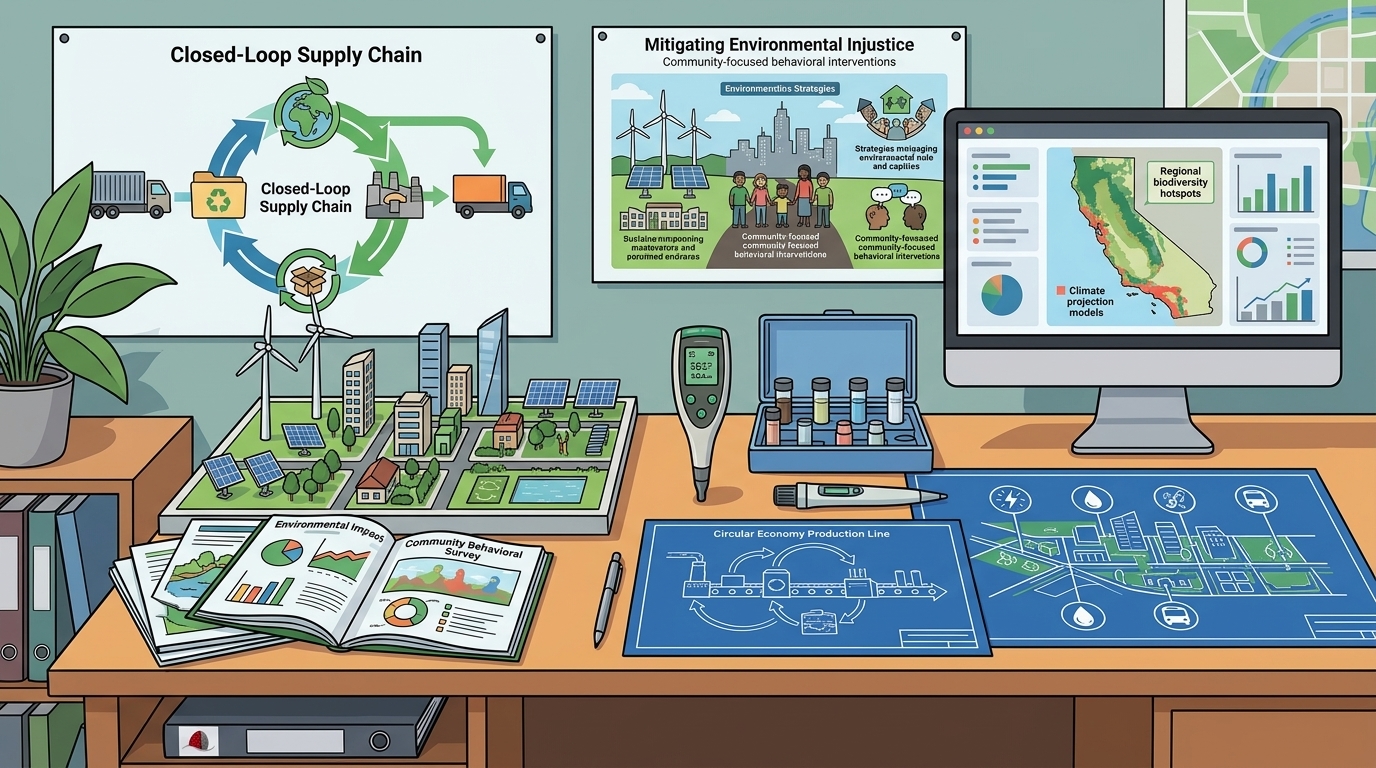
Coursework explores sustainable supply chains, waste management, and circular economy principles. As businesses adopt circular economy models focused on reducing waste and reusing materials, new roles are emerging in recycling innovation and sustainable product design.
Environmental Justice and Social Equity
Sustainability is not just environmental. Programs examine how climate impacts disproportionately affect vulnerable communities, training graduates to design equitable solutions that consider public health, housing, and economic opportunity.
Core Curriculum and Skill Development
A well-designed sustainability master's program blends technical knowledge with strategic thinking. Courses commonly include sustainable energy, public policy, life cycle assessment, ESG frameworks, and sustainable business strategy. Evidentia University's approach adds a unique layer by integrating global sustainability challenges with behavioral insights.
Students develop competencies in data analysis, stakeholder management, project management, and policy literacy. These transferable skills are increasingly sought after across energy, construction, technology, and consulting sectors.
| Career Path | Typical Roles | Median Salary (USD) | Projected Growth |
|---|---|---|---|
| Environmental Science | Environmental Scientist, Analyst | $78,000 | 4% (2024-2034) |
| Renewable Energy | Wind Technician, Solar Installer | $61,000 | 48-60% (2023-2033) |
| Environmental Engineering | Environmental Engineer | $88,000 | 5% (2018-2028) |
| ESG / Sustainability Consulting | ESG Consultant, Sustainability Manager | $95,000+ | High demand |
| Policy and Planning | Policy Analyst, Urban Planner | $80,000 | 9% through 2030 |
Career Outlook and Job Growth
The sustainability job market continues to expand despite political headwinds. According to the U.S. Bureau of Labor Statistics, employment of environmental scientists and specialists is projected to grow 4 percent from 2024 to 2034, with about 8,500 openings each year. Clean energy roles like wind turbine technicians and solar installers are among the fastest-growing occupations nationwide.
Globally, over 16.2 million people were employed in the renewable energy sector as of early 2025, according to IRENA data. LinkedIn's Global Green Skills Report 2024 found that global demand for green talent grew 11.6% between 2023 and 2024, double the rate of supply growth at just 5.6%. This talent gap signals strong career prospects for sustainability graduates.
The Role of Behavioral Science in Sustainability
Behavioral science is the scientific study of how people make decisions and why they act in certain ways. It is a critical yet often overlooked component of sustainability education. Understanding cognitive biases, nudge theory, and decision-making frameworks helps sustainability professionals design interventions that actually change behavior, from reducing energy consumption to increasing recycling rates.
Evidentia University uniquely bridges these disciplines. Their sustainability certificate course and master's program draw on the institution's deep expertise in behavioral and forensic sciences. The university's faculty of over 70 international experts brings academic rigor and real-world professional experience to every course.
Choosing the Right Program
Flexibility and Format
For working professionals, a 100% online program with flexible scheduling is essential. Programs like those at Evidentia University are designed from the ground up for active professionals who need to organize studies around their responsibilities.
Interdisciplinary Approach
The best programs combine environmental science with economics, policy, technology, and human behavior. Look for curricula that include capstone projects or applied research components.
Institutional Credibility
Verify licensure and accreditation. Evidentia University is authorized to operate and grant degrees in the state of Florida by the CIE, Florida Department of Education, and offers internationally recognized credentials. Learn more on their About page.
Key Takeaways
- A Master's in Sustainability prepares graduates to address climate change, resource depletion, and environmental justice through interdisciplinary study.
- Environmental scientist roles are projected to grow 4% from 2024 to 2034, while clean energy jobs are among the fastest growing in the U.S.
- Global demand for green talent is outpacing supply by more than 2:1, creating strong career opportunities.
- Behavioral science insights are essential for designing sustainability interventions that drive real behavior change.
- Online, flexible programs make graduate sustainability education accessible to working professionals worldwide.
- Key skills employers seek include GHG accounting, ESG reporting, life cycle assessment, and stakeholder management.
- Evidentia University's sustainability programs combine behavioral science expertise with evidence-based approaches to environmental challenges.
Frequently Asked Questions
What can you do with a Master's in Sustainability?
Graduates pursue careers as sustainability consultants, environmental scientists, ESG analysts, policy advisors, renewable energy project managers, and corporate sustainability officers. Roles span the private, public, and nonprofit sectors.
How long does a Master's in Sustainability take to complete?
Most programs require 36 credit hours and take approximately 12 to 24 months to complete, depending on full-time or part-time enrollment.
Is a sustainability career still growing in 2025 and beyond?
Yes. Global corporations continue to add sustainability staff, and state and local environmental initiatives remain active. LinkedIn's 2024 data shows green jobs have grown at an annual rate of 12.3% since 2019.
Do I need a science background to enroll?
Not necessarily. Many sustainability master's programs accept students from diverse academic backgrounds including business, social sciences, and the humanities. A bachelor's degree is typically required.
How does behavioral science relate to sustainability?
Behavioral science helps sustainability professionals understand why people resist change and how to design nudges, incentives, and communications that promote sustainable behavior at individual and organizational levels.
What is the salary potential for sustainability professionals?
Salaries vary by role. Environmental engineers earn approximately $88,000 on average, while senior sustainability consultants and managers can earn well over $100,000 annually. Renewable energy workers also saw strong wage growth, with 48% receiving pay raises in 2025.
Can I study sustainability online?
Yes. Many accredited institutions offer fully online sustainability master's programs. Evidentia University, for example, provides a 100% online format with flexible scheduling designed for professionals.
What makes Evidentia University's sustainability program different?
Evidentia University integrates behavioral and forensic science expertise into its sustainability curriculum, offering a unique, evidence-based approach. The program is delivered by an international faculty and is licensed by the Florida Department of Education.
Take the Next Step Toward a Sustainable Career
Ready to turn your passion for the environment into a meaningful career? Explore Evidentia University's Master in Sustainability and discover how behavioral science and evidence-based education can set you apart in one of the world's fastest-growing fields. Request more information today and start building the future you want to see.