

Professional mediators who understand the psychological mechanics behind conflict hold a distinct edge. They read micro-expressions in caucus sessions, anticipate anchoring bias during settlement talks, and design processes that lower cortisol-driven defensiveness. Earning a master's degree that fuses negotiation science with psychological theory is the most direct route to building that expertise—and launching a mediation career with real credibility.
This how-to guide breaks the journey into concrete phases, from prerequisite planning through post-degree certification, so you know exactly what to do at each stage.
Phase 1: Build the Right Undergraduate Foundation
You do not need a single specific major to qualify for a negotiation-focused master's program. Programs routinely admit students from diverse academic backgrounds. At Kennesaw State University's MS in Conflict Management, for example, cohorts include undergraduates from human services, psychology, political science, and English. However, if you want to specialize in the psychology of negotiation, certain undergraduate choices give you a head start:
- Psychology (BA or BS): Gives you grounding in cognitive biases, social influence, and research methods—core knowledge you will apply when studying persuasion dynamics and emotional regulation at the bargaining table.
- Communication Studies: Develops skills in rhetorical analysis and interpersonal conflict frameworks that translate directly into mediation practice.
- Business or Organizational Behavior: Covers decision-making models and managerial negotiation contexts useful for workplace and commercial mediation.
- Pre-Law or Political Science: Familiarizes you with legal systems, administrative procedure, and policy negotiation.
Key undergraduate electives to prioritize
- Social psychology
- Behavioral economics or judgment and decision-making
- Statistics and research design
- Intercultural communication
- Ethics or moral philosophy
Phase 2: Select the Right Graduate Program
Graduate programs in negotiation and conflict resolution are interdisciplinary by nature, drawing on psychology, sociology, law, public policy, and business management. Here is how to narrow the field:
Program formats and timelines
Full-time master's programs in this field typically require two years, though some intensive formats finish in 16–18 months. Part-time and online tracks often take three to four years to accommodate working professionals. Credit requirements generally range from 24 credits on the lower end to 36 credits on the higher end.
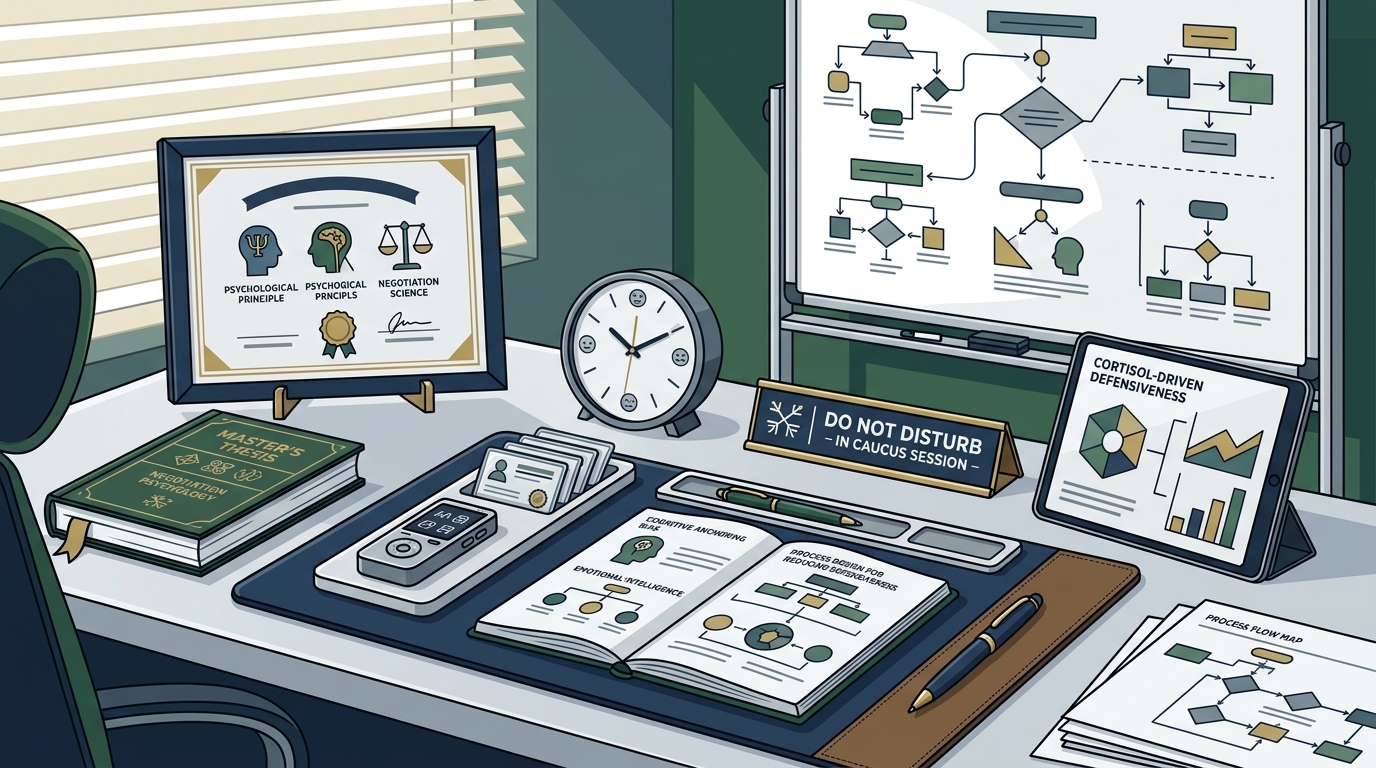
Programs with strong psychology integration
| Institution | Degree | Notable Features |
|---|---|---|
| Columbia University (SPS) | MS in Negotiation and Conflict Resolution | Courses led by scholar-practitioners; capstone project applying theory to real-world conflict; on-campus and online tracks with a two-week residency option |
| University of Baltimore | MS in Negotiations and Conflict Management | 36-credit interdisciplinary program; partnership with the Federal Mediation and Conciliation Service (FMCS); no standardized test required |
| UMass Boston | MA in Conflict Resolution | Nation's oldest program of its kind; explores social, psychological, political, and cultural factors in conflict; includes UN facilitator certification opportunity |
| Kennesaw State University | MS in Conflict Management | 16-month cohort model with weekend classes; field study capstone with research, internship, or workshop options |
| CSUDH | MA in Negotiation, Conflict Resolution & Peacebuilding | Fully online and asynchronous; completable in two years; covers mediation, negotiation, and conflict management skills |
| Lasell University | MS in Communication (Negotiations & Conflict Resolution) | Draws from behavioral economics, psychology, and dispute resolution; case studies include hostage negotiations, M&A, and employment mediation |
Evaluation criteria to compare programs
- Psychology depth: Look for courses in cognitive bias, emotional intelligence, motivational psychology, and behavioral decision-making—not just survey-level conflict theory.
- Practicum or internship requirement: Programs that mandate supervised mediation hours accelerate your readiness for certification.
- Faculty credentials: Prioritize programs where instructors are active scholar-practitioners who publish peer-reviewed research and mediate real disputes.
- Capstone format: Options such as applied research projects, field studies, or comprehensive exams let you tailor the culminating experience to your career goals.
- Professional partnerships: Affiliations with agencies like the FMCS or court systems provide direct pathways into practicum placements and employment.
Phase 3: Navigate the Admissions Process
Most graduate programs in this field require a bachelor's degree for admission. Beyond that baseline, here is what to prepare:
- Transcripts: Demonstrating strong performance in social science or humanities courses signals readiness for graduate-level behavioral content.
- Letters of recommendation: Aim for references from professors or supervisors who can speak to your interpersonal skills, analytical thinking, or conflict management experience.
- Personal statement: Articulate a clear connection between your interest in psychological science and your mediation career goals. Programs value specificity—explain which types of disputes you want to mediate and why psychology matters in those contexts.
- Work experience (sometimes required): Some programs ask applicants to have professional experience in dispute resolution or a related field.
- Standardized tests: Many programs in this field—including the University of Baltimore—have dropped GRE requirements entirely, lowering a traditional barrier to entry.
Phase 4: Maximize Your Time in the Program
Enrollment is only the starting line. To emerge with the competencies that set psychology-informed mediators apart, you need a deliberate strategy throughout your coursework.
Core coursework domains
Expect your curriculum to span several interconnected areas. Typical courses across programs include:
- Conflict theory and analysis
- Decision-making and negotiation
- Intercultural dispute resolution
- Mediation skills and practice
- Divorce and family mediation
- Organizational conflict management
- Research methods in conflict studies
Elective strategy for psychology depth
Choose electives that deepen your understanding of human behavior under pressure. Where available, take courses in:
- Neuroscience of decision-making
- Trauma-informed practice
- Group dynamics and social identity theory
- Persuasion science and influence
- Cross-cultural psychology
Practicum and internship hours
Supervised practice is non-negotiable for aspiring mediators. UMass Boston allows students to become mediators for the Commonwealth of Massachusetts through its mediation internship course. Other programs partner with community mediation centers, court systems, or international organizations. Log every hour—you will need documented experience for post-degree certification.
Capstone project guidance
Most programs culminate in a capstone course, project, or internship. Treat this as a portfolio piece. For example, you could design a mediation protocol for a specific dispute type (e.g., tech-sector employment disputes) grounded in cognitive-behavioral research, producing a deliverable you can present to prospective employers or clients.
Phase 5: Obtain Professional Mediator Certification
A master's degree provides the theoretical backbone, but certification signals competence to courts, employers, and clients. Certification requirements vary significantly by state and organization.
National certifications
- National Association of Certified Mediators (NACM): The largest professional certification association in the world for mediators. Applicants must upload proof of at least 40 hours of advanced mediation training, then complete an online study guide and examination.
- International Mediation Institute (IMI): Sets the international gold standard. IMI Qualified Mediators have completed a quality training program, while IMI Certified Mediators are highly experienced professionals who meet rigorous international benchmarks. Useful if you plan to mediate cross-border or commercial disputes.
State court certification (U.S.)
State requirements differ widely. In some states like Alaska, there are no statewide licensing or certification requirements. In others, the process is detailed:
- North Carolina: Non-attorney applicants need a four-year degree plus 10 years of high-level professional experience, or alternative qualifying combinations, plus completion of a 40-hour mediation training program and case observations.
- Florida: Requires Florida Supreme Court certification through a points-based system that credits education, training, and mentored mediation experience.
- New York: Community Dispute Resolution Centers require a 30-hour basic mediation training, followed by an apprenticeship involving case observations, co-mediations with certified mediators, and in-service training modules.
Research your target state's requirements early—ideally before choosing your master's program—so you can align practicum hours and training with local certification standards.
Professional associations worth joining
Key organizations include the Association for Conflict Resolution, the International Association for Conflict Management, and the International Ombuds Association. These groups host professional development conferences, publish research guides, and create networking opportunities that help you build referral relationships.
Phase 6: Launch and Grow Your Mediation Practice
With your degree and certification in hand, the final phase is building a sustainable career. Here is where the psychology specialization pays dividends.
Career paths available to you
Graduates of conflict resolution master's programs pursue a wide variety of roles. Common career paths include:
- Court-referred mediator (family, civil, or commercial)
- Human resources conflict specialist
- Labor relations mediator
- Organizational development consultant
- International peacebuilding practitioner
- Policy analyst or dispute systems designer
- Private practice mediator and negotiation coach
Salary and job market outlook
The median annual salary for arbitrators, mediators, and conciliators is approximately $67,710 as of 2025 BLS data. The Bureau of Labor Statistics projects employment in this category to grow 4–6% through 2033–2034, reflecting steady demand as organizations and courts increasingly turn to alternative dispute resolution.
Building a psychology-informed brand
Position yourself at the intersection of behavioral science and dispute resolution. Consider these strategies:
- Publish articles or case commentaries that apply cognitive-behavioral concepts to real mediation scenarios
- Offer negotiation psychology workshops for corporate HR departments or law firms
- Develop continuing education content for fellow mediators on topics like implicit bias or emotional contagion in multi-party disputes
- Seek advanced training in complementary areas like divorce coaching, collaborative law facilitation, or arbitration
Key Takeaways
- A psychology-oriented undergraduate foundation helps, but programs accept diverse academic backgrounds—your personal statement and relevant experience matter more than a specific major.
- Select a master's program based on psychology course depth, practicum quality, faculty credentials, and alignment with your target state's certification requirements.
- Most programs take two years full-time and require 24–36 credits, with online and part-time options available for working professionals.
- Post-degree certification—whether through NACM, IMI, or state court systems—is essential for professional credibility and court referral eligibility.
- The median mediator salary is approximately $67,710, with steady projected job growth of 4–6% through the mid-2030s.
- A psychology specialization differentiates you in the market and opens doors to consulting, training, and private practice beyond traditional court mediation.
Frequently Asked Questions
How long does it take to earn a master's in negotiation and conflict resolution?
Most master's programs require two years of full-time study, though some accelerated formats can be completed in 16–18 months. Part-time and online options typically take three to four years, making them accessible for working professionals who cannot pause their careers.
Do I need a psychology undergraduate degree to enter a negotiation master's program?
No. Graduate programs in this field are intentionally interdisciplinary and accept applicants from psychology, political science, English, human services, law, business, and other backgrounds. That said, foundational psychology coursework—especially social psychology and research methods—strengthens both your application and your readiness for graduate-level behavioral content.
What certifications should I pursue after earning my master's?
The three main pathways are: NACM certification (requiring at least 40 hours of advanced mediation training plus an examination), state court-certified mediator status (requirements vary significantly by jurisdiction), and IMI certification for mediators who want to practice internationally. Research your target jurisdiction's specific requirements before you graduate so you can align your practicum hours accordingly.
What is the salary outlook for mediators with a master's degree?
The BLS reports a median annual salary of approximately $67,710 for arbitrators, mediators, and conciliators as of 2025. Employment in this field is projected to grow 4–6% through 2033–2034. Specializing in high-value niches—such as commercial mediation, employment disputes, or international conflict—can push compensation well above the median.
Can I complete this degree entirely online?
Yes. Programs at institutions like CSUDH, the University of Baltimore, and Columbia University offer fully online or hybrid formats. CSUDH's program is entirely asynchronous, allowing students anywhere in the world to complete the degree with only internet access. Columbia's online track includes one two-week in-person residency.