

Whether you are investigating fraudulent product claims, studying deceptive marketing tactics, or trying to understand how consumers respond to misleading cues, finding the right research consulting partner is critical. This guide maps every major category of provider—from global market-research giants to niche deception-detection specialists—so you can match your project scope to the right expertise.
Why Analyzing Deceit Signals in Consumer Behavior Matters Now
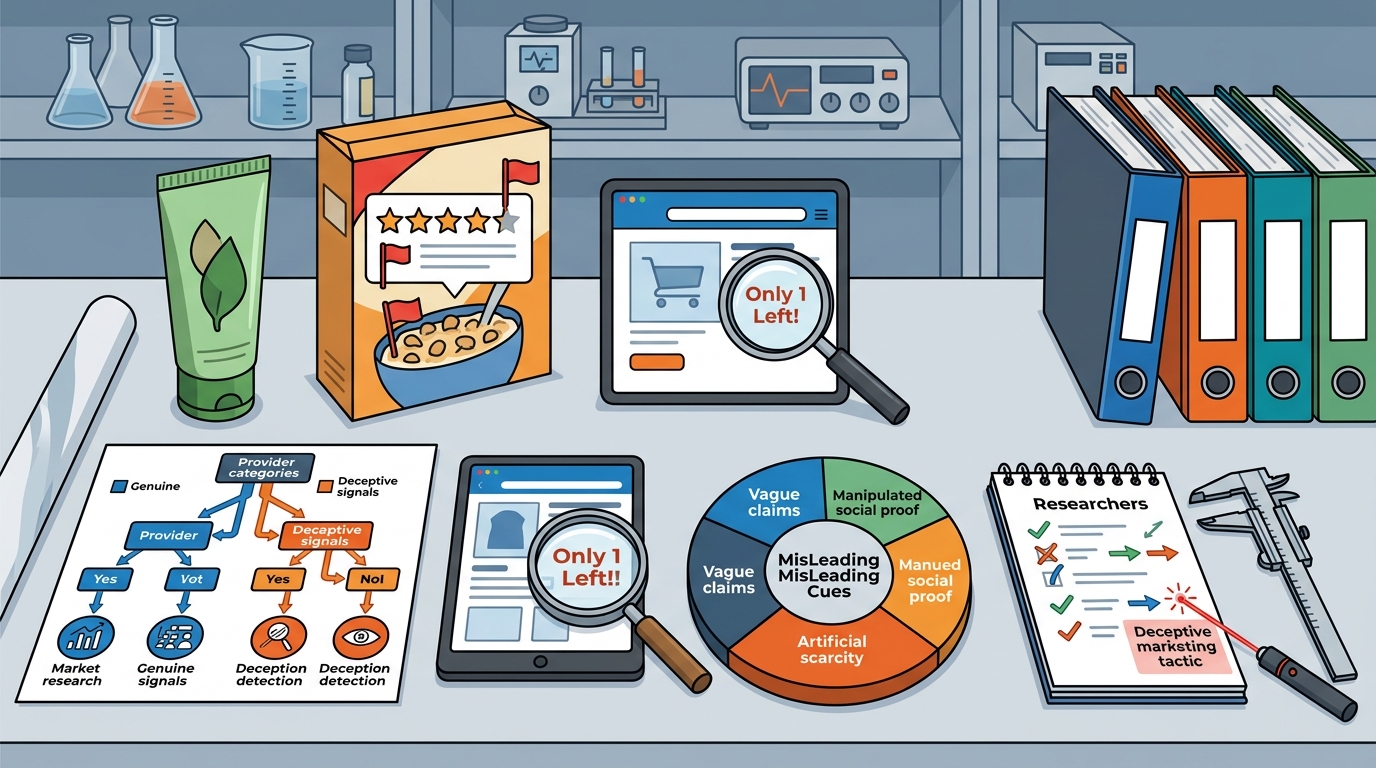
Deceptive signals are everywhere in modern commerce. Vague sustainability claims, manipulated social proof, and misleading urgency cues all distort consumer decision-making. Recent research has shown that unverifiable green marketing signals—such as vague environmental language and function-stacking—significantly boost sales on e-commerce platforms, yet their effectiveness is contextually shaped by platform governance and consumer expectations. Understanding these dynamics is no longer optional for brands that want to build lasting trust.
At the same time, consumers themselves are growing more skeptical. Analytics indicate that vague sustainability claims cause 41 percent of shoppers to abandon their carts, while customer-generated video content boosts conversions by 3.2 times. The gap between authentic and deceptive signals has real revenue consequences, making specialized research consulting indispensable.
7 Categories of Research Consulting Services for Deceit-Signal Analysis
No single firm covers every angle. Below are seven distinct categories of providers, each with unique strengths for studying the intersection of consumer behavior and deception.
1. Global Market Research & Analytics Firms
Large-scale consultancies offer the broadest datasets and cross-market benchmarking capability. They are ideal when you need to study deceptive signals across multiple geographies or product categories simultaneously.
- Kantar Group — Headquartered in London with over 28,000 employees, Kantar provides insights and consulting services across industries including brand strategy, consumer insights, and media effectiveness.
- GfK / NIQ — Their recent merger expanded global reach and enhanced analytical capabilities, providing a more holistic view of consumer behavior and market trends.
- Circana (formerly IRI) — Specializes in combining holistic and granular data, using verified consumer panels, e-commerce data scraping, and credentialed panels to enhance reliability over self-reported purchase data.
- Bain Consumer Lab — Helps brands connect consumer behavior research and macro forces with business decisions and outcomes, leveraging longitudinal research, AI-enabled tools, and knowledge from industry experts.
2. Behavioral Science & Deception-Detection Consultancies
When your research question centers on whether consumers—or companies—are lying, you need consultancies grounded in the science of deception rather than general market research.
- Truth Intelligence Consulting — A firm whose work is grounded in science, from cognitive-based interviewing to deception-detection practices validated by world-renowned experts in behavioral and social science. They caution that many popular techniques like body-language interpretation and microexpression reading lack validated scientific credibility.
- Evidentia University Research Programs — Academic programs and faculty research at institutions like Evidentia University offer rigorous, peer-reviewed methodologies for studying deceit signals in consumer contexts, bridging the gap between theoretical frameworks and applied consulting.
This category is especially relevant for fraud investigations, false-advertising litigation, and internal compliance audits where the accuracy of deception detection is paramount.
3. Neuromarketing & Biometric Research Labs
Neuromarketing has grown into a vital tool for understanding consumer decision-making, offering insights into customers' motives, preferences, and choices. The field integrates neuroimaging techniques such as fMRI, EEG, and eye-tracking to capture neural, physiological, and attentional data simultaneously.
Advanced machine learning algorithms applied to multimodal data—including brain signals, facial expressions, and physiological indicators—can more accurately predict purchasing decisions, preferences, and emotional reactions. These methods are powerful for detecting subconscious responses to deceptive cues that consumers may not articulate in surveys or interviews.
Look for labs affiliated with research universities or established firms like Neurons (formerly Neurons Inc.) and iMotions that provide both academic rigor and commercial applicability.
4. University-Affiliated Research Centers
Academic institutions remain an underutilized resource for organizations seeking deep, methodologically rigorous analysis of consumer deception. Faculty experts in behavioral economics, psychology, and marketing science publish peer-reviewed work and often accept consulting engagements or sponsored research projects.
Programs focused on marketing analytics teach students and professionals to collect, process, and analyze data to generate actionable insights. Many universities also operate consumer behavior labs with eye-tracking, implicit association testing, and survey experimentation capabilities.
5. Litigation-Focused Survey Research Consultancies
When deceit-signal analysis must hold up in court, litigation-grade survey research firms are essential. NERA Economic Consulting, for example, provides expert testimony on the design, implementation, analysis, and critique of surveys, with work presented before the FTC and the European Commission. Their economists use quantitative research, choice models, and survey techniques for disputed issues such as false advertising and Lanham Act claims of alleged trademark infringement.
These firms combine deep knowledge of sampling techniques, survey administration, and complex dataset analysis with a grounding in econometric principles—essential when deception claims must survive legal scrutiny.
7. Boutique Qualitative & Ethnographic Agencies
Sometimes deceit signals are subtle and cultural—requiring deep immersion rather than big data. Boutique qualitative agencies specialize in focus groups, in-depth interviews, ethnographic research, and digital qualitative studies led by experienced researchers who uncover the reasons behind audience attitudes.
- Touchstone Research — A qualitative market research agency that helps brands understand the motivations, emotions, and behaviors behind consumer decisions, operating across more than 60 international markets.
- HumanBranding — Uses Applied Anthropology Thinking to go deeper beneath the surface to understand human behavior, an approach that can illuminate cultural dimensions of deception.
How to Evaluate a Research Consulting Partner
Not every firm is the right fit. Use these criteria when shortlisting:
- Methodological transparency — Ask whether their deception-detection practices are validated by peer-reviewed science. Many popular techniques have no basis in validated credibility.
- Data source diversity — The best partners combine qualitative and quantitative methods. Mixing open-ended qualitative research with quantitative analytics and CRM data yields the most complete picture.
- Industry-specific experience — A firm studying deceit in pharmaceutical advertising needs different expertise than one analyzing greenwashing in e-commerce.
- Legal defensibility — If findings may be used in litigation, ensure the firm has experience presenting evidence before regulatory bodies.
- Privacy compliance — The regulatory landscape is increasingly complex, and consumer privacy is a growing concern. Verify that data collection methods comply with applicable laws.
- AI and technology stack — Leading firms now leverage AI for data synthesis, pattern detection, and theme discovery, freeing analysts to spend more time on interpretation.
Key Takeaways
- Research consulting for consumer deceit signals spans at least seven distinct provider categories—from global analytics firms to niche deception-detection specialists.
- Deception-detection methods must be grounded in validated behavioral science, not pop-psychology techniques.
- Neuromarketing tools like fMRI, EEG, and eye-tracking can reveal subconscious responses to deceptive cues that surveys miss.
- Litigation-grade survey research is essential when findings must withstand regulatory or courtroom scrutiny.
- Social listening platforms are critical for identifying online deception patterns such as fake reviews and manipulated engagement.
- Always verify a consulting partner's methodological rigor, data privacy compliance, and industry-specific track record before engaging.
Frequently Asked Questions
- What are deceit signals in consumer behavior research?
- Deceit signals are cues—verbal, visual, or behavioral—that indicate misleading intent, whether from a brand toward consumers (e.g., greenwashing, fake urgency) or from consumers toward businesses (e.g., fraudulent returns, false claims). Research consultancies use behavioral science, survey design, and neuroimaging to identify and measure these signals.
- How much do consumer behavior research consulting services typically cost?
- Costs vary widely. Social listening platform subscriptions may start at a few hundred dollars per month, while a comprehensive neuromarketing study or litigation-grade survey project can range from $50,000 to $500,000+ depending on scope, sample size, and geographic coverage.
- Can AI replace human researchers in detecting consumer deception?
- AI dramatically accelerates pattern detection and data synthesis, but human expertise remains essential for interpretation. Leading firms implement human-led AI that is tested with real teams and evaluated with clear metrics to ensure accuracy and relevance.
- What is the difference between neuromarketing and traditional consumer research?
- Traditional methods rely on self-reported data through surveys and interviews. Neuromarketing integrates neuroimaging techniques such as fMRI, EEG, and eye-tracking to capture neural and physiological responses, revealing subconscious reactions that consumers may not articulate consciously.
- Where can I find academic research on consumer deception?
- University-affiliated research centers, peer-reviewed journals in marketing and behavioral science, and programs like those at Evidentia University publish ongoing research. Many faculty members also accept sponsored research projects or consulting engagements with industry partners.
- How do I know if a deception-detection method is scientifically valid?
- Look for methods validated through peer-reviewed studies. Be cautious of techniques based on body language interpretation or microexpressions, as many lack scientific validation. Cognitive-based interviewing and signal-detection frameworks with published accuracy metrics are more reliable.
6. Social Listening & Digital Signal Platforms
Modern deception often plays out online—through fake reviews, misleading influencer endorsements, and manipulated engagement metrics. Social listening platforms help surface these signals at scale.
These tools are particularly useful for detecting coordinated inauthentic behavior, review manipulation, and sentiment anomalies that may indicate deceptive marketing practices.