

How to Become a Certified Criminal Profiler Through Online Graduate Studies
Criminal profiling is one of the most sought-after specializations in forensic and behavioral science, yet the path to becoming a certified practitioner is often misunderstood. Unlike what popular TV dramas suggest, real-world profilers combine rigorous graduate education, investigative experience, and evidence-based methodology. The good news is that accredited online programs now make it possible to earn graduate-level credentials from anywhere in the world. This guide walks you through the educational requirements, certification options, core skills, and career outlook so you can chart a clear path toward becoming a criminal profiler.
What Is Criminal Profiling?
Criminal profiling is the systematic application of behavioral science, victimology, and crime-scene analysis to infer relevant offender characteristics and help investigators prioritize hypotheses and resources. It is also referred to as criminal investigative analysis, a term widely used by the FBI and other federal agencies.
In practice, profilers combine deductive reasoning, inductive comparisons, psychological inference, and geographic cues to produce transparent, auditable conclusions. The goal is a structured set of inferences that clearly state what the evidence supports, what it does not, and the ethical limits of interpretation. Understanding this distinction separates the evidence-based practitioner from the Hollywood archetype.
Education Requirements for Criminal Profilers
There is no single mandated degree for criminal profilers, but graduate-level education is strongly correlated with career success. In a well-known survey of top criminal profilers conducted by the FBI, 87.5 percent held graduate degrees. Most professionals pursue a master's or doctoral degree in forensic psychology, criminology, criminal justice, or behavioral science.
Undergraduate Foundation
A bachelor's degree in psychology, criminal justice, forensic science, or a related behavioral discipline is the typical starting point. The FBI, for instance, requires at minimum an undergraduate degree for special-agent candidates.
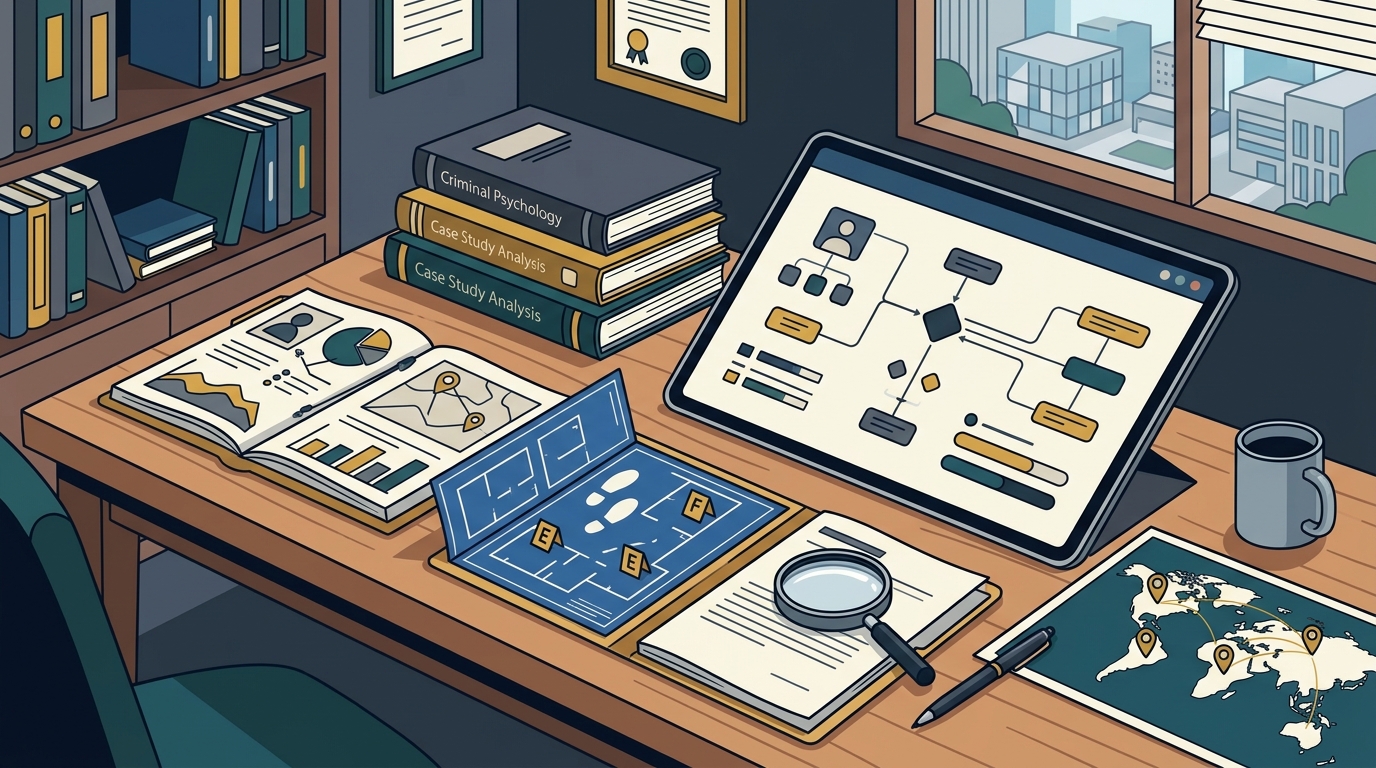
Graduate Specialization
A graduate program focused specifically on criminal profiling provides the advanced training that employers expect. Programs like the Master in Criminal Profiling at Evidentia University are designed to equip students with advanced skills in behavioral analysis, forensic psychology, and crime scene investigation through a 100% online format.
Investigative Experience
Education alone is rarely sufficient. Most investigative professionals accumulate seven to fifteen years of field experience before transitioning into dedicated profiling roles. Hands-on casework builds the judgment that classroom theory cannot fully replicate.
Online Graduate Programs in Criminal Profiling
Flexible, fully online graduate programs have made specialized criminal profiling training accessible to working professionals worldwide. Below is a comparison of program types available at Evidentia University.
| Program | Format | Duration | Credential Earned |
|---|---|---|---|
| Master in Criminal Profiling | 100% Online | Approx. 12-18 months | Master of Science degree |
| Certificate in Criminal Profiling | 100% Online | 12 weeks | Professional Certificate + CEUs |
| FBI Methodology Course | 100% Online | 4 weeks | Certificate of Completion + CEUs |
Evidentia University is licensed by the Florida Department of Education and features a faculty that includes former FBI Behavioral Analysis Unit agents, PhD criminologists, and law-enforcement commanders. The online learning environment combines self-paced video lessons with live guest-speaker sessions, real-case simulations, and daily tutor support.
Core Profiling Methods You Will Learn
A quality graduate program teaches multiple profiling frameworks so graduates can apply the right tool to each investigation.
Behavioral Evidence Analysis (BEA)
Behavioral Evidence Analysis is a deductive method of criminal profiling that builds conclusions exclusively from the evidence found in a specific case. The BEA method follows a structured four-step process: equivocal forensic analysis, victimology, crime-scene characteristics, and offender characteristics. Every conclusion must be directly supported by the evidence, making it a scientifically defensible standard.
Inductive and Statistical Profiling
Inductive profiling uses casebases and typologies to compare incidents, identify pattern linkages, and document decision thresholds. Responsible application requires explicit error considerations to avoid overgeneralization.
Geographic Profiling
Geographic profiling is the modeling of spatial patterns to identify comfort zones, anchor points, and likely activity areas. It integrates route analysis and buffer zones with the behavioral narrative of the case to help prioritize search efforts.
Professional Certification Options
Certification validates your expertise to employers and the courts. Several pathways exist depending on your background.
The Certified Criminal Profiler (CCP) credential, administered by the McAfee Institute, is a board certification that requires a combination of education and experience plus a written exam. Eligibility typically requires a bachelor's degree plus four years of relevant experience, or equivalent combinations of education and fieldwork.
The Professional Certificate in Criminal Profiling from Evidentia University offers a practice-oriented credential earned over 12 intensive weeks, with sessions led by seasoned investigators, PhD academics, and advisors to law-enforcement agencies. Upon completion, graduates receive a certificate from the School of Continuing Education along with Continuing Education Units.
Additionally, agencies like the ATF run a competitive 13-week internal program for senior special agents, and the International Criminal Investigative Analysis Fellowship (ICIAF) accepts law-enforcement candidates for advanced training.
Essential Skills and Career Outlook
Successful criminal profilers blend analytical rigor with strong communication. Critical thinking and behavioral observation form the core, supported by written and verbal reporting skills, knowledge of forensic science, and a deep understanding of legal procedure.
The U.S. Bureau of Labor Statistics classifies criminal profilers under police and detectives, projecting steady demand in the coming decade. Salary data from PayScale and FBI reports places median base salaries for profilers near $58,000, with entry-level FBI special agents starting around $52,440 before locality adjustments.
Career paths extend beyond traditional law enforcement. Graduates of programs like Evidentia University's Master in Criminal Profiling pursue roles as forensic psychologists, behavioral consultants, expert witnesses, and academic researchers. The interdisciplinary nature of profiling opens doors across government agencies, private-sector security firms, and international organizations.
Key Takeaways
- Criminal profiling requires a blend of graduate education and real-world investigative experience; 87.5% of top profilers hold graduate degrees.
- Online programs such as the Master in Criminal Profiling at Evidentia University make specialized training accessible to working professionals worldwide.
- The Behavioral Evidence Analysis (BEA) method is a deductive, case-specific framework considered a modern, scientifically defensible standard.
- Professional certifications like the CCP from the McAfee Institute and certificates from Evidentia University validate your expertise for employers and courts.
- Core skills include critical thinking, behavioral observation, forensic science literacy, and clear legal communication.
- Median salaries for criminal profilers are approximately $58,000, with FBI entry-level agents starting near $52,440.
- Career opportunities span law enforcement, consulting, expert testimony, academia, and private security.
Frequently Asked Questions
Do I need a specific degree to become a criminal profiler?
There is no single required degree. However, a graduate degree in forensic psychology, criminology, criminal justice, or behavioral science is strongly recommended. Most successful profilers hold at least a master's degree, and many agencies require one for advanced positions.
Can I complete criminal profiling training entirely online?
Yes. Accredited institutions like Evidentia University offer 100% online programs, including a full Master in Criminal Profiling and a 12-week Professional Certificate, both designed for working professionals who need scheduling flexibility.
What is Behavioral Evidence Analysis (BEA)?
Behavioral Evidence Analysis is a deductive method of criminal profiling that bases all conclusions exclusively on the evidence found in a specific case. It was developed to be more systematic, testable, and scientifically defensible than older inductive models.
How long does it take to become a criminal profiler?
The timeline varies. After earning a bachelor's degree (4 years) and a master's degree (1-2 years), most professionals gain 7 to 15 years of investigative experience before moving into dedicated profiling roles. Certificate programs can be completed in as few as 12 weeks for supplemental credentials.
What certifications are available for criminal profilers?
The Certified Criminal Profiler (CCP) from the McAfee Institute is a recognized board certification. Evidentia University also issues Professional Certificates and Continuing Education Units through its School of Continuing Education. Some federal agencies offer internal certification through programs like the ATF's behavioral analysis training.
What is the salary range for a criminal profiler?
Median base salaries are approximately $58,000 according to PayScale data. FBI entry-level special agents earn around $52,440 before locality pay adjustments, which can significantly increase total compensation depending on geographic region.
What career paths are open to criminal profiling graduates?
Graduates can pursue roles as criminal profilers, forensic psychologists, behavioral consultants, jury consultants, expert witnesses, law-enforcement advisors, or university researchers. The analytical skills developed in profiling programs also transfer well to private-sector security and intelligence roles.
Take the Next Step in Your Criminal Profiling Career
If you are ready to turn your interest in criminal behavior into a professional credential, explore the Master in Criminal Profiling or the 12-week Professional Certificate in Criminal Profiling at Evidentia University. Both programs are 100% online, taught by former FBI agents and international experts, and designed to give you the evidence-based tools you can put to work immediately. Request information today and secure your place in the next cohort.